Advanced Killer Sudoku strategies
When the single cells run out, the rule of 45 still has more to give. These six techniques stretch it across several rows or boxes, split cages that cross a border, and then bring the cages back together with ordinary Sudoku logic.
Two rows, columns or boxes side by side add up to 90, and three add up to 135. The diagrams use the same colours as the basic page: green marks the cells the step is about, blue marks cells it compares them with, grey shades the area being added up, purple marks a cell you test against, and red with a cross is a candidate you remove.
The rule of 45, further
Across two rows
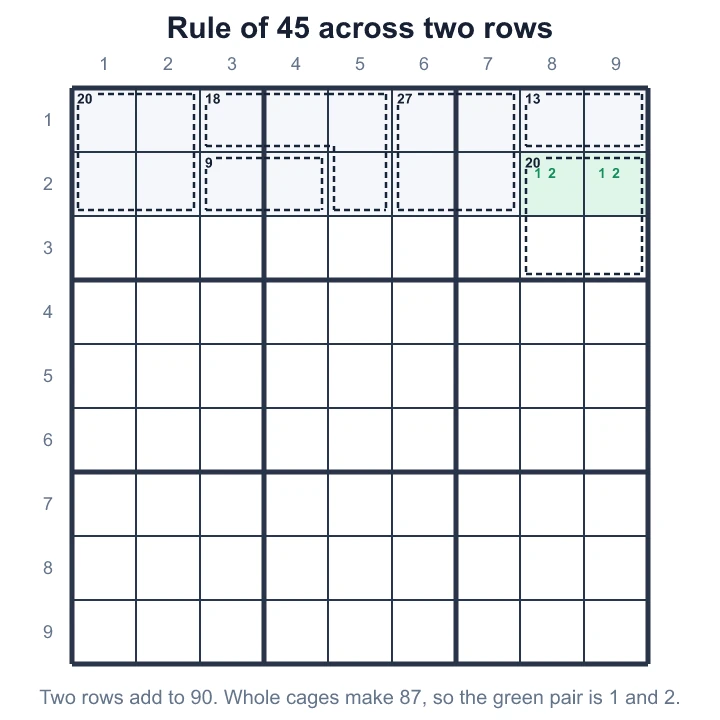
Seeing it. Pick two or three neighbouring rows, columns or boxes. The cells that aren't in whole cages inside the area may not be next to each other or in one cage, but together they act like a cage of their own.
Using it. Take the whole cages' total from 90 (or 135) to get that hidden cage's sum, then use it like any other cage. In the diagram rows 1 and 2 add to 90. Their whole cages make 20 + 18 + 9 + 27 + 13 = 87, so the two green cells add to 3. Two cells adding to 3 can only be 1 and 2.
The rule of 45, further
One cell in, one cell out
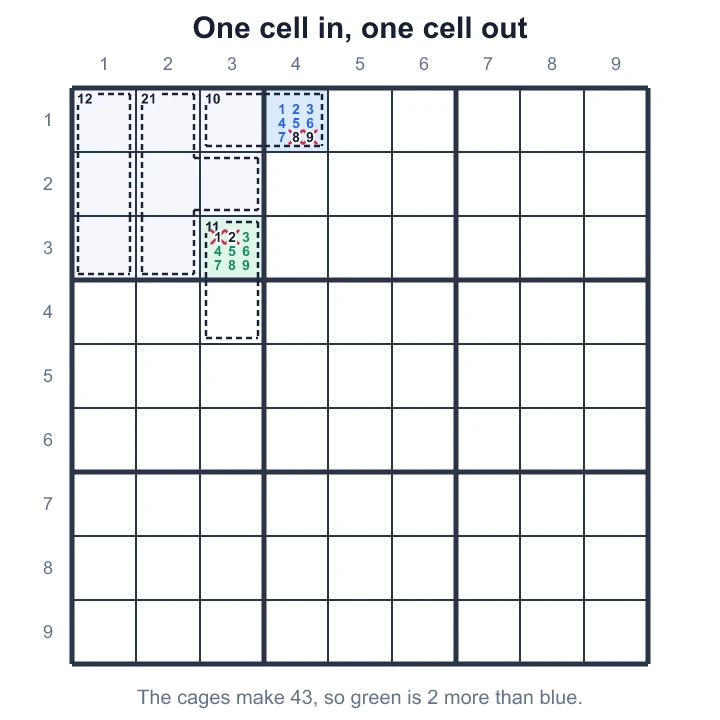
Seeing it. A set of whole cages covers a box (or row, or column) except for one cell inside it, and has one cell sticking out of it. You know neither cell, but you can work out the difference between them.
Using it. The cages' total is 45, minus the cell inside, plus the cell outside. In the diagram the cages make 12 + 21 + 10 = 43, so the green cell inside is 2 more than the blue cell outside. Green can't be 1 or 2, and blue can't be 8 or 9. As either cell gets narrower, the other follows.
The rule of 45, further
Splitting a cage
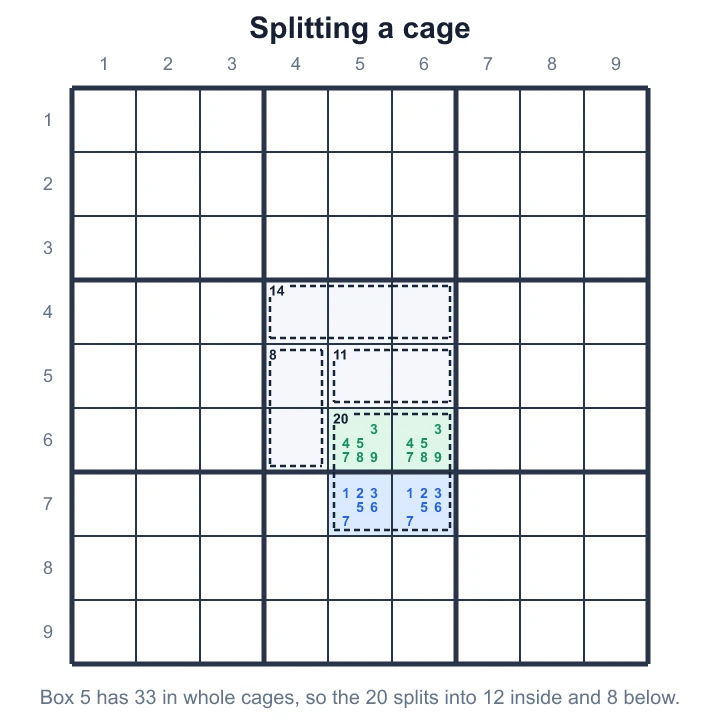
Seeing it. A cage crosses the edge of a row, column or box, and every other cell of that area is in whole cages.
Using it. Work out what the part inside the area must add to, then take that from the cage's sum to get the part outside. You now have two smaller cages instead of one big one. In the diagram box 5's whole cages make 14 + 8 + 11 = 33, so the 20 cage's two cells inside the box add to 45 − 33 = 12, and its two cells below add to 8. A 12 in two cells is 3+9, 4+8 or 5+7, and an 8 is 1+7, 2+6 or 3+5, so each cell loses the digits it can't use.
Cages and units
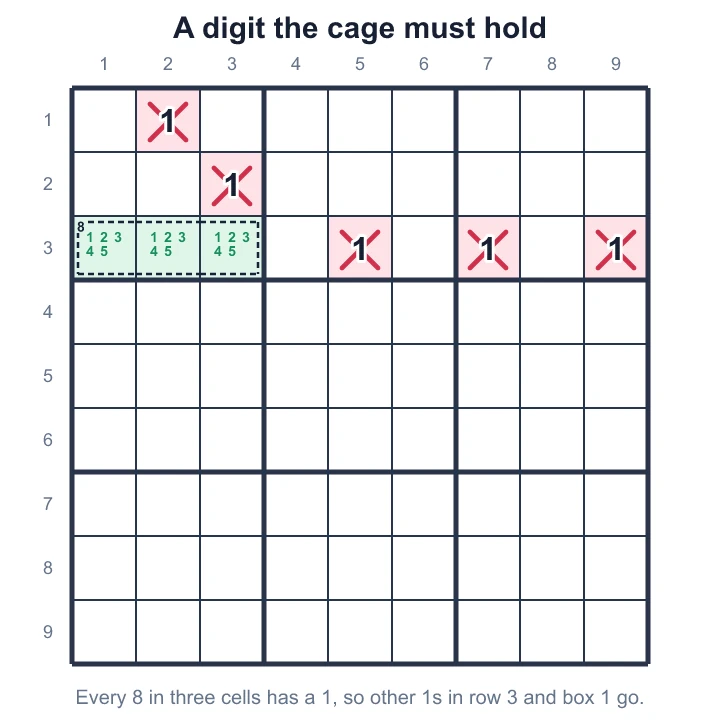
A digit the cage must hold
Seeing it. Every combination left for a cage contains the same digit. You don't know which cell it's in, but it has to be somewhere in the cage.
Using it. If the whole cage lies in one row, column or box, cross that digit off the rest of it. In the diagram an 8 in three cells is 1+2+5 or 1+3+4, and both include 1. The cage sits in row 3 and in box 1, so no other cell in either can be 1. It works the other way round too: if a box can only put a digit inside one cage, every combination for that cage without the digit is out.
Cages and units
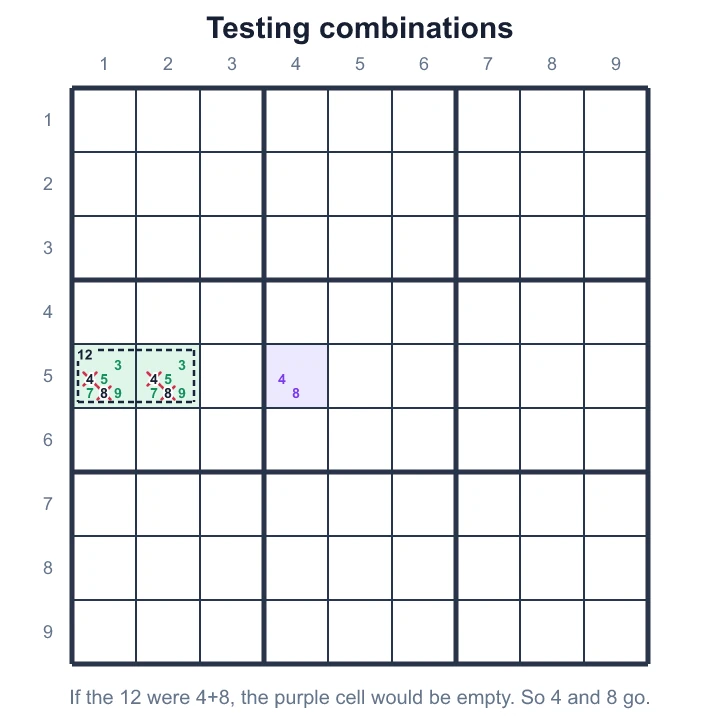
Testing combinations
Seeing it. One of a cage's combinations would use up every digit another cell or cage in the same row, column or box needs.
Using it. Try each combination against the cells around it, and drop any that leaves another cell or cage with nothing. In the diagram the 12 cage is 3+9, 4+8 or 5+7. A cell in the same row can only be 4 or 8, so if the cage took both, that cell would be empty. The cage can't be 4+8, and its cells lose 4 and 8.
Row, column and box logic
Sudoku techniques still work
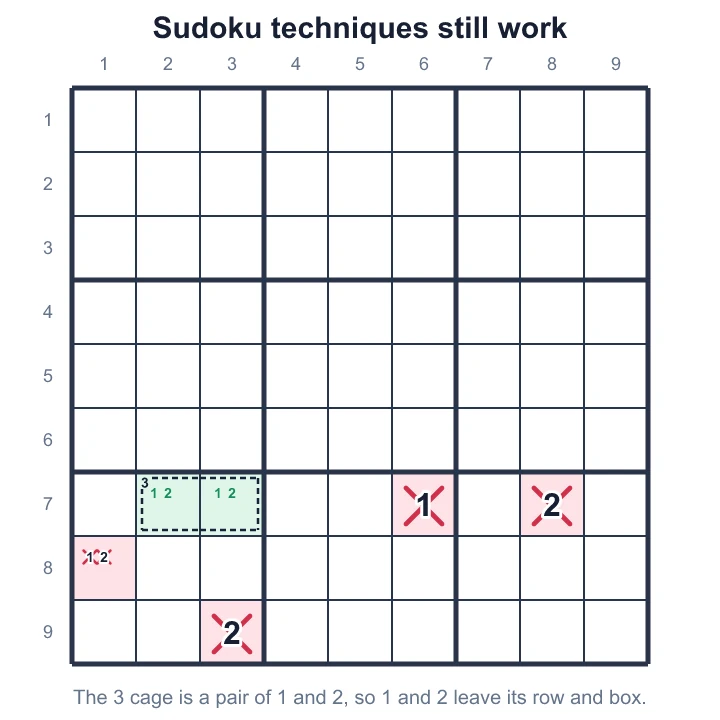
Seeing it. A Killer Sudoku is still a Sudoku, so every technique from our Sudoku pages works on it. Cages make a lot of them easy to spot. A two-cell cage with one combination is a naked pair the moment you pencil it in.
Using it. In the diagram the 3 cage must be 1 and 2. Those two cells take both digits between them, so 1 and 2 come off the rest of row 7 and box 7. Pointing pairs, X-Wings and chains all work the same way. Our basic, intermediate and advanced Sudoku strategies explain them with diagrams.