Connect the islands with bridges, without ever crossing them.
Hashiwokakero, usually shortened to Hashi and also known as Bridges, is a logic puzzle from Japan. The grid is scattered with islands, each showing a number. Your job is to connect the islands with bridges so that every island has exactly as many bridges as its number, and all the islands are joined into one connected group.
The rules are simple. Bridges run in straight lines across or down, never diagonally. Two islands can be joined by one bridge or two, but no more. And bridges can never cross each other or pass over an island. That's all there is to it, and there are no sums to do: Hashi is pure logic.
What makes it so satisfying is the way the solve unfolds. An island in a corner with a big number has only a few ways to reach its neighbours, so it often gives you a starting point. Each bridge you draw limits the next, and on a large grid you'll see long chains of deductions fall into place across the whole page. Many solvers like to tick off an island once its bridges are complete, so they can see at a glance which ones still need work.
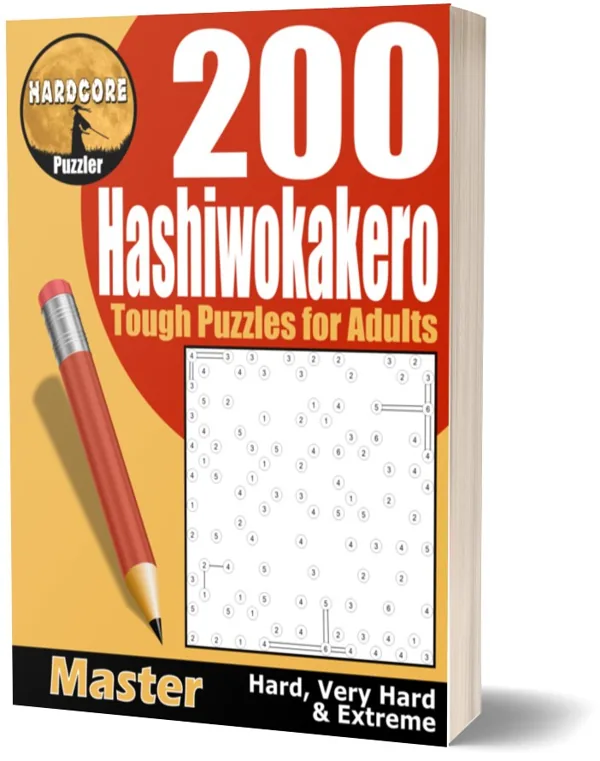
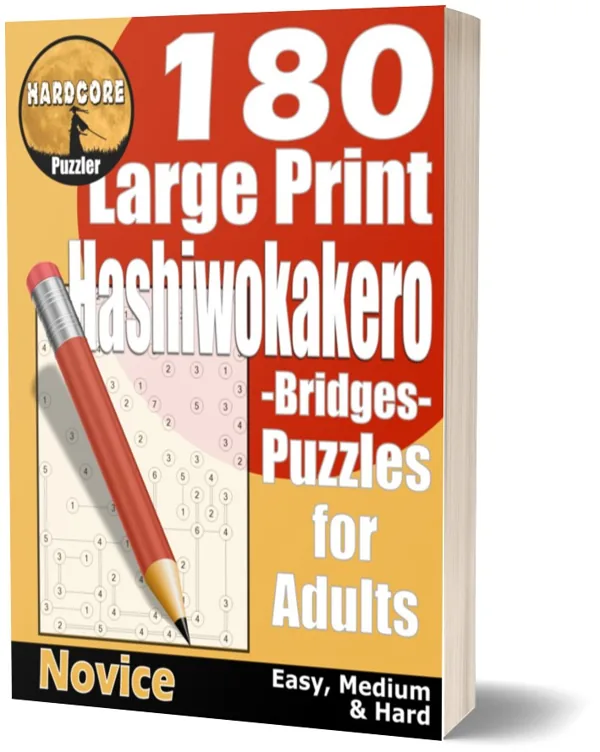
We publish two Hashi series. Hard Core Hashiwokakero 200 has 200 tough puzzles, from Hard to Extreme, on grids that grow from 12x12 up to a giant 30x30, with the rules at the front and every solution in the back. 180 Large Print Hashi (Bridges) is printed large with one puzzle per page: 60 puzzles at each of three levels, with solving tips at the front and every solution in the back. Its Novice book starts on 9x12 grids and its Master book reaches 21x28.
Each series page below explains what's inside and who the books suit. If you enjoy Hashi, you may also like Hidoku and Numbrix, which ask you to trace one unbroken number path, and Minesweeper, another grid of pure deduction.