
Minesweeper Puzzle Books
The classic game on paper, with full-page grids.
Minesweeper is the classic computer game, rebuilt as a pen-and-paper logic puzzle. The grid hides a number of mines. Some squares show a number, which tells you how many mines are in the squares touching it, including diagonally. Every other square starts blank, and the mines can only be in blank squares, though not every blank square holds one. Using the clues, you work out exactly where every mine is hiding. The numbers are your only clues, so every one matters.
On paper, the game changes in the best way. There's no timer and no wrong click to end it all, so you can take your time and think each move through. Every deduction is yours to make: a 1 next to a single unknown square gives away a mine, two neighbouring clues can rule out a whole row of squares, and before long you'll be spotting the classic patterns at a glance. Mark the squares you know are safe as well as the mines; both kinds of mark feed the next deduction.
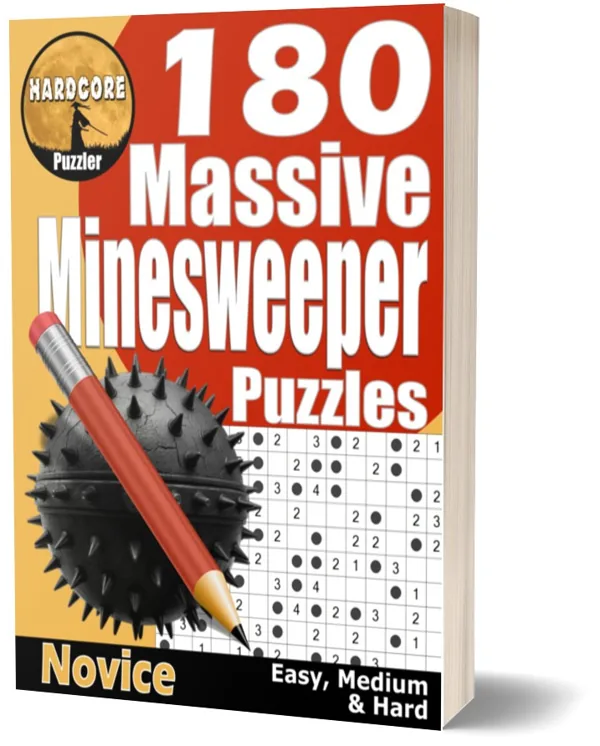
Our Minesweeper series is 180 Massive Minesweeper. As the name suggests, the grids are big, with full-page puzzles and room on each page to mark your deductions. There are 180 puzzles per book, and three books to choose from. Novice is the place to start if you're new to the paper version. Adept steps up the challenge for solvers who know the basic patterns. Master is for experienced solvers who want long, demanding grids.
It's a screen-free way to enjoy a game many people first met on a computer, and a satisfying change from number-placement puzzles like Sudoku. There's no arithmetic beyond counting to eight, so it suits anyone who enjoys careful logic. It also makes a thoughtful gift for anyone who remembers the computer version.
If you enjoy Minesweeper, you may also like Hashi, where you connect islands with bridges, and Hidoku and Numbrix, where you trace a single number path through the grid. Both share the same pleasure of steady, step-by-step deduction.
The books
Questions
How do the numbers work?
A number tells you how many mines are in the up to eight squares touching it, including diagonally. A square with a number never holds a mine. All the other squares start blank: some hide mines and some don't, and the clues tell you which.
Do I ever have to guess?
No. Every puzzle can be solved by logic alone, so there's always a safe deduction to make.
Which Minesweeper book should I start with?
Start with 180 Massive Minesweeper Novice, then move up to Adept and Master as the patterns become familiar.