Advanced Sudoku strategies
These are the techniques for expert and extreme puzzles: colouring, uniqueness arguments, chains and almost locked sets. They build on the strong and weak links from the intermediate page, so read that first if the terms are new.
Cell references are short: r2c8 means row 2, column 8. A strong link means a digit has exactly two places in a unit, so one of them must be it. A weak link means two candidates see each other, so at most one can be true. In the diagrams, green and blue mark the two sides of a pattern, purple lines show links, and red with a cross marks the candidate you remove.
A note on the uniqueness techniques. They only work if the puzzle has exactly one solution. Every Hardcore Puzzler puzzle does, so they're safe to use in our books. Be careful with puzzles from sources that don't make that promise.
Colouring
Colour trap
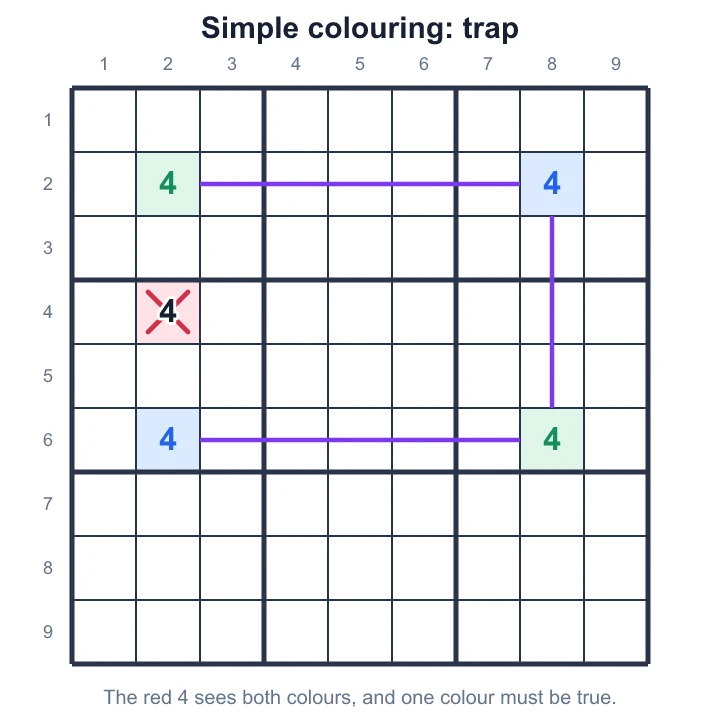
Seeing it. Pick one digit and follow its strong links, giving the cells two colours that alternate along the chain. In the diagram, 4 starts green at r2c2. Row 2 has 4 only there and at r2c8, so r2c8 is blue. Column 8 links r2c8 to r6c8 (green), and row 6 links r6c8 to r6c2 (blue). Now look for an uncoloured 4 that sees one green and one blue cell. r4c2 sees green r2c2 and blue r6c2, both up and down column 2.
Using it. In a colour chain, either every green cell is the digit or every blue cell is. Whichever colour wins, r4c2 shares column 2 with a 4, so it can't be 4. Remove it.
Colouring
Colour wrap
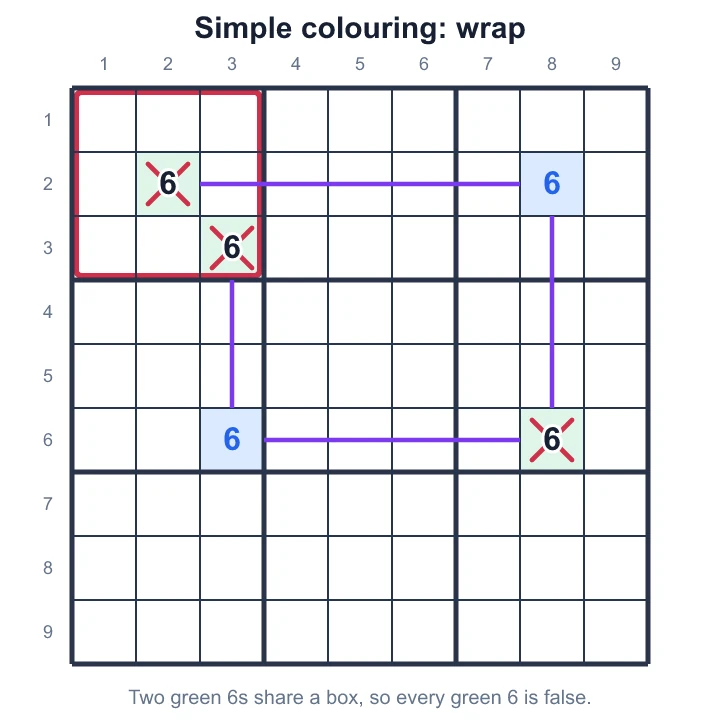
Seeing it. Build a colour chain the same way, then check whether two cells of the same colour share a unit. In the diagram, 6 runs green at r2c2, blue at r2c8 (row 2), green at r6c8 (column 8), blue at r6c3 (row 6) and green again at r3c3 (column 3). r2c2 and r3c3 are both green, and both in the top-left box.
Using it. Two 6s can't share a box, so green is impossible everywhere in the chain. Remove 6 from every green cell and place 6 in every blue cell: r2c8 and r6c3. A wrap often solves several cells at once.
Uniqueness
Unique Rectangle Type 1
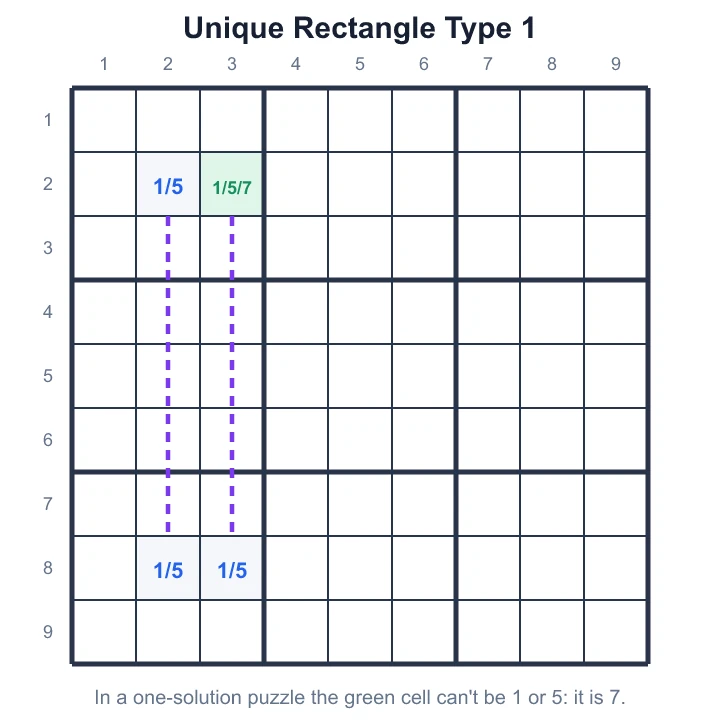
Seeing it. Look for four cells at the corners of a rectangle spanning exactly two rows, two columns and two boxes. Three corners hold the same pair, and the fourth holds that pair plus something extra. In the diagram, r2c2, r8c2 and r8c3 each hold 1/5, and r2c3 holds 1/5/7.
Using it. If r2c3 were 1 or 5, the four corners would form a deadly pattern. The 1s and 5s could swap places without breaking any rule, and the puzzle would have two solutions. A one-solution puzzle can't contain that, so r2c3 must be 7. The two-box condition matters. Spread the same rectangle across four boxes and the swap would break the boxes, so there's no deadly pattern and no deduction.
Uniqueness
Unique Rectangle Type 2
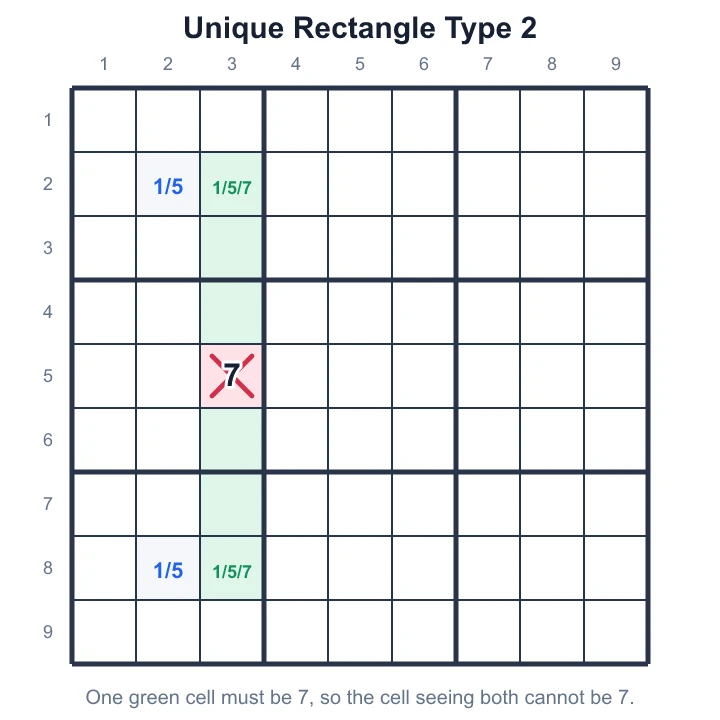
Seeing it. The same rectangle, but now two corners on the same side carry the same extra digit. In the diagram, r2c2 and r8c2 hold 1/5, while r2c3 and r8c3 both hold 1/5/7.
Using it. If neither of the two extra cells were 7, all four corners would be 1/5 and the puzzle would have two solutions. So one of them is 7. Any cell that sees both can't be 7: here, r5c3, further down column 3. If the two extra cells also share a box, clear 7 from that box too.
Uniqueness
BUG+1
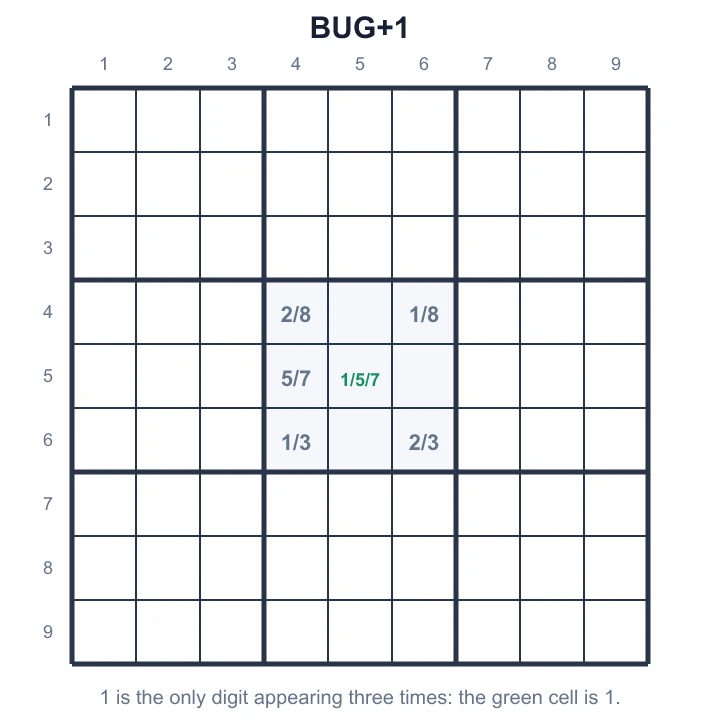
Seeing it. BUG stands for Bivalue Universal Grave. It turns up late in a puzzle, when every unsolved cell has exactly two candidates except one cell with three, and every candidate appears exactly twice in each row, column and box apart from that one cell's extra. In the diagram, every other cell shown in the centre box has two candidates, and the centre, r5c5, holds 1/5/7. Count the 1s in the box: r4c6, r6c4 and r5c5 make three. Every other digit appears exactly twice, so 1 is the extra.
Using it. If r5c5 weren't 1, every cell in the grid would have two candidates, each digit twice per unit, and a grid like that can never have just one solution. So r5c5 is 1. Check the whole grid before you trust this. One other cell with three candidates breaks the pattern, and "nearly all two-candidate cells" isn't enough.
Chains
Remote Pair
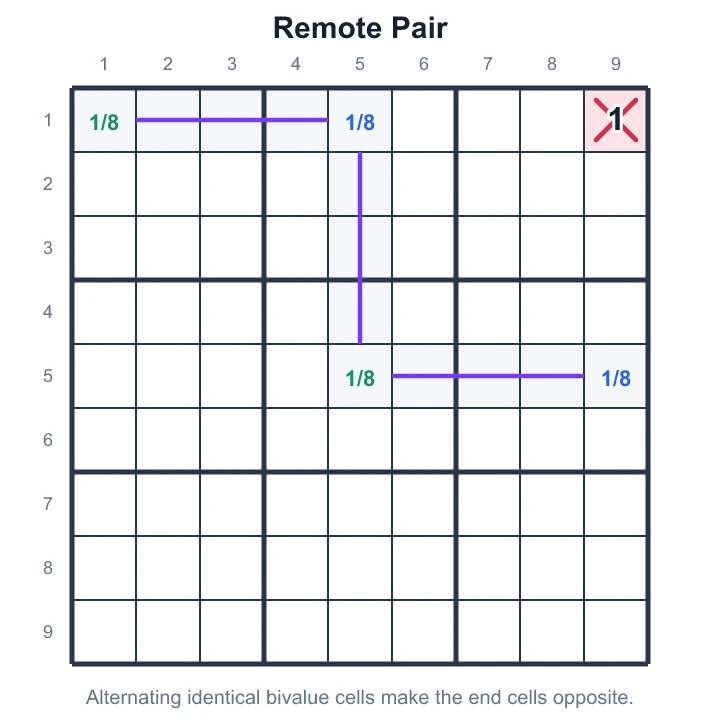
Seeing it. Look for a chain of cells that all hold the same pair, each one seeing the next. In the diagram, r1c1, r1c5, r5c5 and r5c9 all hold 1/8, linked along row 1, down column 5 and along row 5.
Using it. Neighbouring cells in the chain must be opposites, so the values alternate all the way along. With four cells (any even number), the two ends are opposites: one is 1 and the other is 8. Any cell that sees both ends can be neither. r1c9 shares row 1 with one end and column 9 with the other, so remove 1 and 8 from it. With an odd number of cells, the ends match and you learn nothing.
Chains
X-Chain
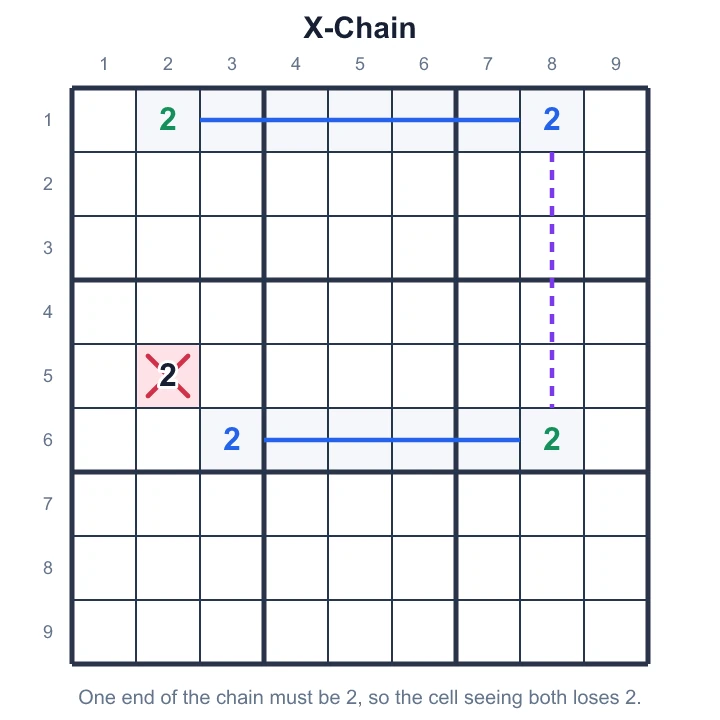
Seeing it. An X-Chain uses one digit only, alternating strong and weak links and starting and ending on a strong one. In the diagram, row 1 has 2 only at r1c2 and r1c8 (strong). r1c8 and r6c8 share column 8 (weak). Row 6 has 2 only at r6c8 and r6c3 (strong). Skyscrapers, Kites and Turbot Fish are all short X-Chains.
Using it. Follow it through. If r1c2 isn't 2, r1c8 is, so r6c8 isn't, so r6c3 is. One end or the other is 2. Remove 2 from any cell that sees both ends: r5c2 shares column 2 with r1c2 and the left-middle box with r6c3. Longer chains work the same way. Mark each link as strong or weak as you go, because one mislabelled link breaks the whole proof.
Chains
XY-Chain
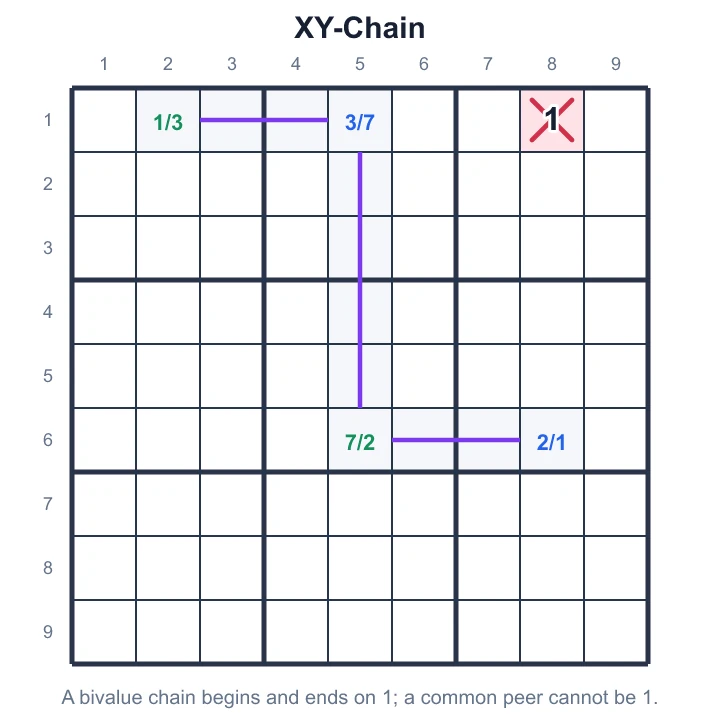
Seeing it. Link cells that each have two candidates, where each cell shares a digit with the next, and the first and last cells both contain the same digit. In the diagram, r1c2 (1/3) links to r1c5 (3/7), then r6c5 (7/2), then r6c8 (2/1). Both ends contain 1.
Using it. Suppose r1c2 isn't 1. Then it's 3, so r1c5 is 7, so r6c5 is 2, so r6c8 is 1. Either the start or the end is 1. r1c8 sees both, along row 1 and down column 8, so it can't be 1. An XY-Wing is just a three-cell XY-Chain.
Chains
Alternating Inference Chain (AIC) and Nice Loop
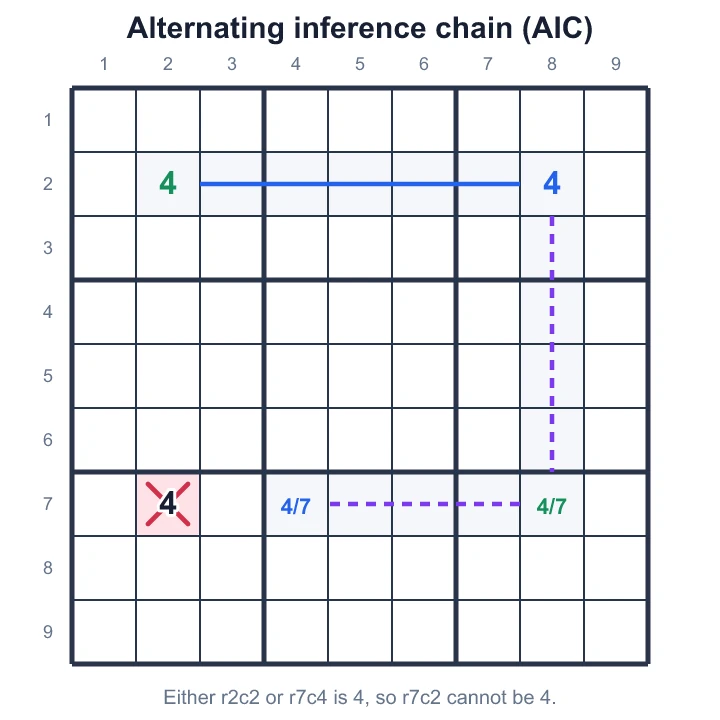
Seeing it. An AIC lets you mix links between digits and links inside cells. A strong link can be a digit with two places in a unit, or a cell with exactly two candidates (if it isn't one, it's the other). In the diagram, row 2 has 4 only at r2c2 and r2c8. r2c8 sees r7c8 in column 8. r7c8 holds 4/7, so its 4 and 7 are strongly linked. Its 7 sees the 7 in r7c4 along row 7, and r7c4 also holds 4/7.
Using it. Read it in plain words. If r2c2 isn't 4, then r2c8 is 4, so r7c8 isn't 4, so r7c8 is 7, so r7c4 isn't 7, so r7c4 is 4. Either r2c2 or r7c4 is 4. r7c2 sees both, up column 2 and along row 7, so its 4 goes. When a chain closes back on its starting cell, it's called a Nice Loop, and every weak link in the loop can then produce eliminations of its own.
Chains
Forcing chain and forcing net
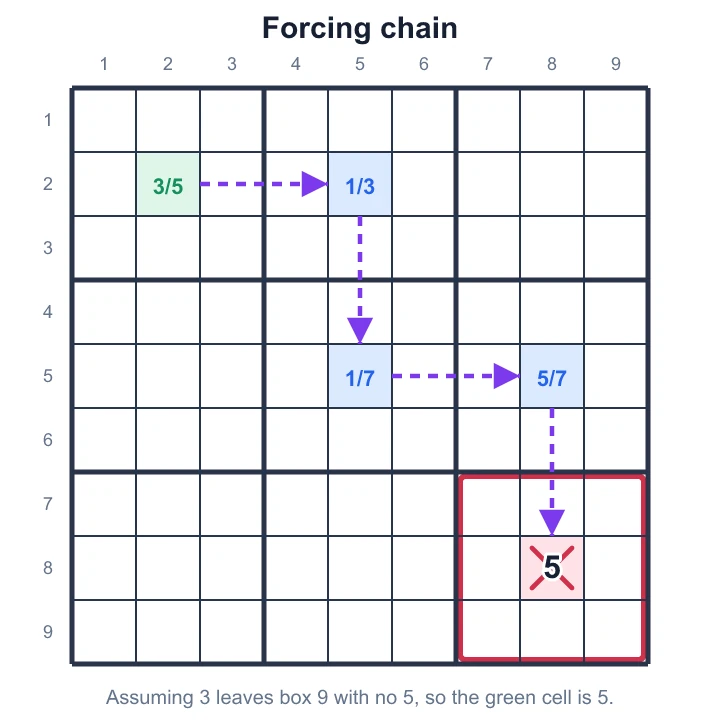
Seeing it. Pick a cell with two candidates, assume one of them, and follow what it forces. In the diagram, r2c2 holds 3/5. Assume it's 3. Then r2c5 (1/3) must be 1, so r5c5 (1/7) must be 7, so r5c8 (5/7) must be 5, which rules out the 5 at r8c8. But r8c8 is the last place for 5 in box 9 (outlined in red), so the box is left with no 5.
Using it. The assumption led to a broken grid, so it was false. r2c2 isn't 3, which makes it 5. This is proof by contradiction, not guessing: you show one choice is impossible instead of hoping it works. A forcing net is the same idea with branches, where one placement forces several others at once. You can also try both values of a cell; if both paths lead to the same result, that result is true. If you're more than a dozen steps into a chain, look again for a simpler pattern first.
Almost locked sets
ALS-XZ
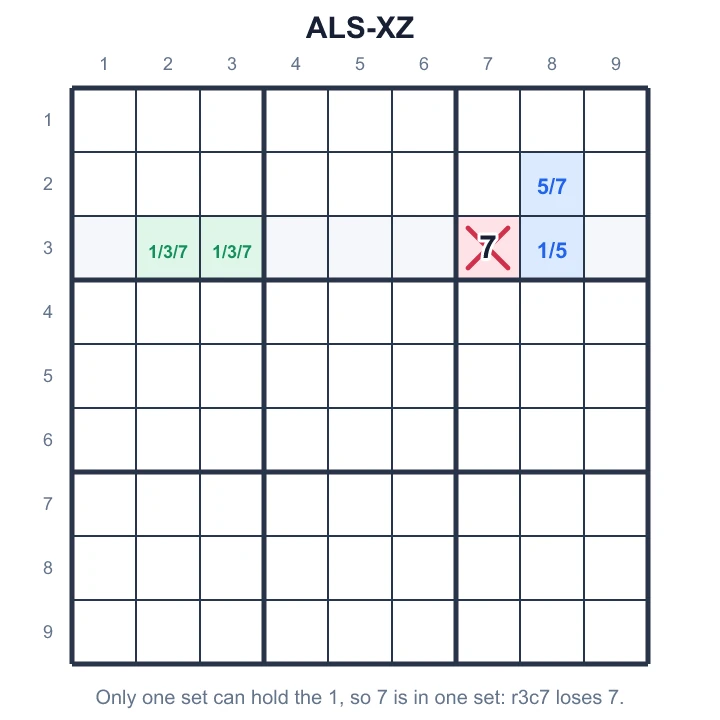
Seeing it. An almost locked set (ALS) is a group of cells in one unit holding one more candidate than it has cells: two cells with three digits, three cells with four. Remove one candidate and it becomes a naked subset. In the diagram, set A (green) is r3c2 and r3c3, holding 1/3/7 between them. Set B (blue) is r2c8 (5/7) and r3c8 (1/5), holding 1/5/7. They share two digits, 1 and 7. Every 1 in both sets is in row 3, so only one of the sets can have the 1. That shared digit is the restricted common, X. The other shared digit, 7, is Z.
Using it. Whichever set doesn't get the 1 becomes a locked pair. A would be 3 and 7, or B would be 5 and 7. Either way, 7 lands in A or in B. Any cell that sees every 7 in both sets can't be 7. r3c7 sees r3c2 and r3c3 along row 3 and r2c8 in box 3, so remove its 7. ALS-XZ is the entry point to the longer ALS techniques, such as ALS chains.