Intermediate Sudoku strategies
When singles, locked candidates and subsets stop working, hard puzzles move on to the patterns on this page. Every one of them needs full pencil marks, so fill in all the candidates before you start looking.
Cell references are short from here on: r2c8 means row 2, column 8. The diagrams use green for the cells that make the pattern, blue for linked cells or the lines being cleared, purple for connections and fins, and red with a cross for the candidate you remove.
Two kinds of link come up again and again. A strong link means a digit has exactly two places in a unit, so if one isn't the digit, the other must be. The diagrams draw these as solid lines. A weak link means two candidates see each other, so at most one of them can be true. These are dashed.
Fish
X-Wing
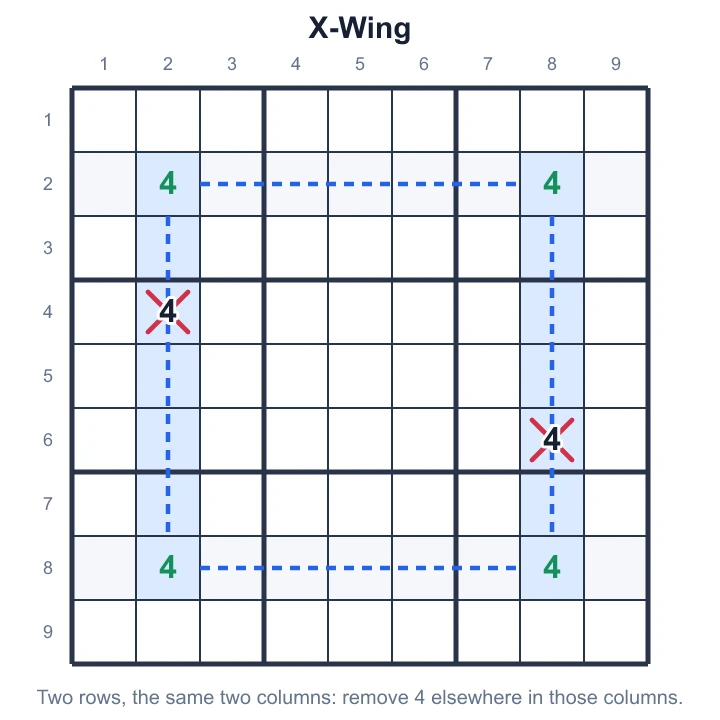
Seeing it. Pick a digit and look for two rows where it has exactly two candidates, both in the same two columns. The four cells make the corners of a rectangle. In the diagram, 4 appears in row 2 only at columns 2 and 8, and in row 8 only at columns 2 and 8. You can also build an X-Wing from two columns, using rows as the sides.
Using it. Row 2's 4 goes in one corner and row 8's 4 in the corner diagonally opposite. Whichever diagonal it turns out to be, column 2 and column 8 each get their 4 from these corners. Remove 4 from every other cell in those two columns: r4c2 and r6c8.
Fish
Swordfish
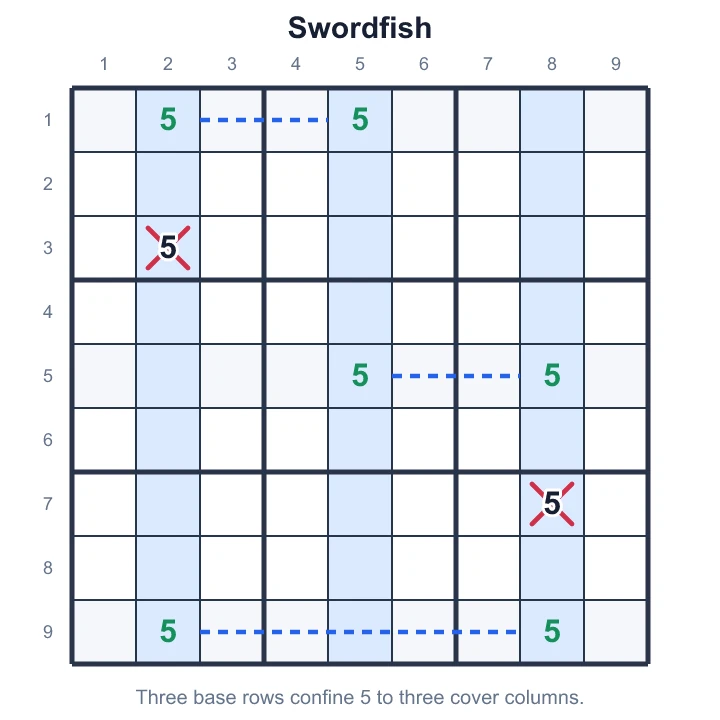
Seeing it. An X-Wing with three rows and three columns. Find three rows where a digit appears only in the same three columns, two or three times per row. In the diagram, 5 sits in row 1 at columns 2 and 5, in row 5 at columns 5 and 8, and in row 9 at columns 2 and 8. That's three rows using only columns 2, 5 and 8. The shape doesn't look like a neat grid, which is why Swordfish get missed.
Using it. The three rows need three 5s, and they can only come from columns 2, 5 and 8, one in each. That fills each of those columns' 5. Remove 5 from the other cells in the three columns: r3c2 and r7c8. Check for the column version too: three columns confining a digit to three rows.
Fish
Jellyfish
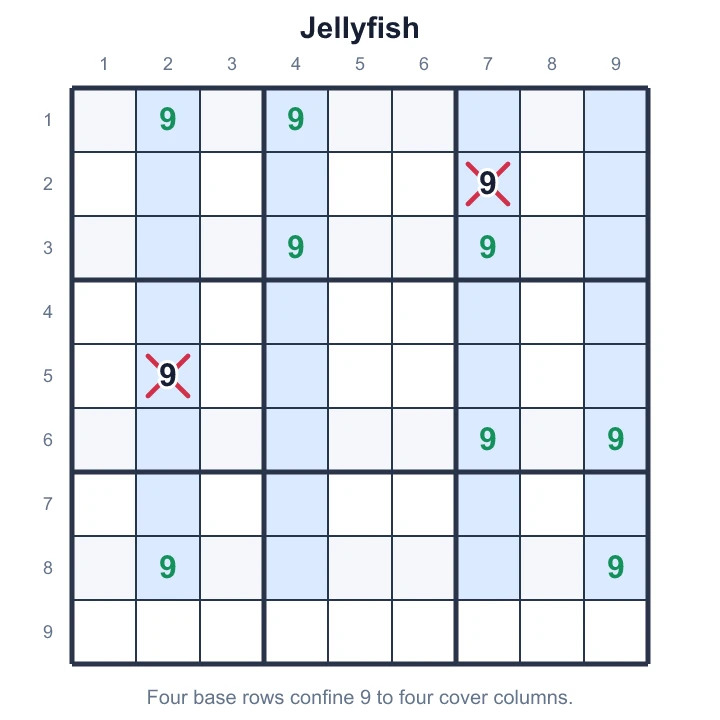
Seeing it. Four rows that keep one digit inside the same four columns. In the diagram, 9 appears in row 1 at columns 2 and 4, row 3 at columns 4 and 7, row 6 at columns 7 and 9, and row 8 at columns 2 and 9.
Using it. Four rows, four 9s, all placed in columns 2, 4, 7 and 9. Remove 9 from every other cell in those columns: r5c2 and r2c7. Jellyfish are rare, and they're hard to see by eye. Look for them when a single digit has many candidates left late in the puzzle.
Fish
Finned and Sashimi fish
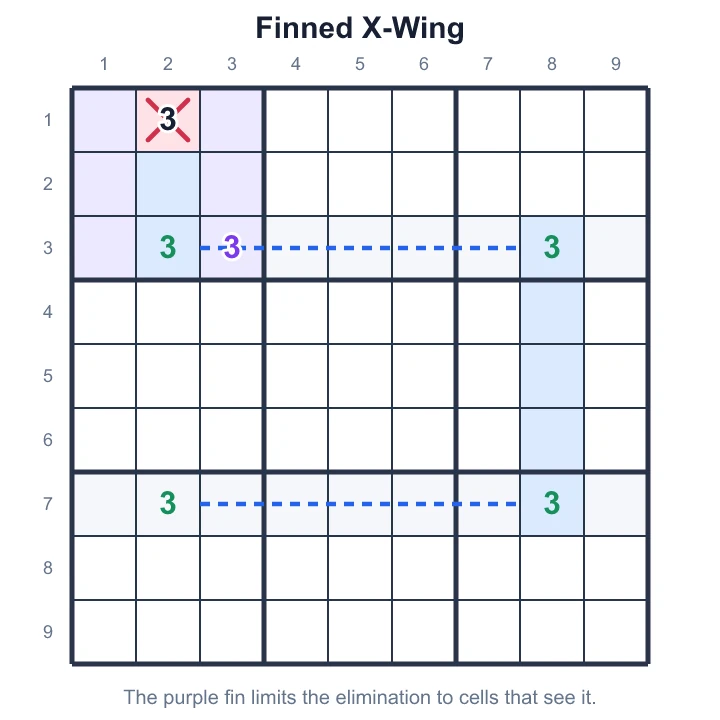
Seeing it. Start with something that is almost an X-Wing (or Swordfish, or Jellyfish), spoilt by one or two extra candidates in the same box as one corner. The extra is the fin. In the diagram, 3 appears in row 7 at columns 2 and 8, and in row 3 at columns 2 and 8 plus column 3. Without the purple 3 at r3c3, it would be a plain X-Wing. A Sashimi fish is the same idea when one corner of the pattern is also missing.
Using it. Either the X-Wing holds, or the fin is the 3. Only a cell that sits in one of the fish's columns and also sees the fin is safe to clear in both cases. Here that's r1c2. If the X-Wing holds, column 2 gets its 3 from r3c2 or r7c2. If the fin is true, r3c3 is 3 and the top-left box can't have another. Remove 3 from r1c2, and leave the rest of columns 2 and 8 alone.
Wings
XY-Wing (Y-Wing)
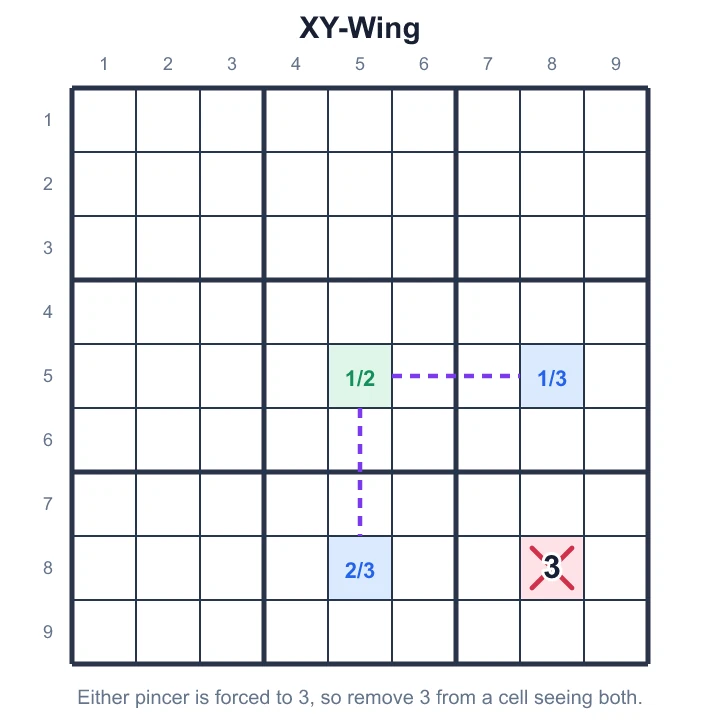
Seeing it. You need three cells with two candidates each. The pivot, r5c5, holds 1/2. It sees two pincers: r5c8 with 1/3 in the same row, and r8c5 with 2/3 in the same column. Each pincer shares one digit with the pivot, and both pincers share the third digit, 3.
Using it. If the pivot is 1, r5c8 must be 3. If the pivot is 2, r8c5 must be 3. Either way, one pincer is 3. Any cell that sees both pincers can't be 3. In the diagram, r8c8 shares row 8 with one pincer and column 8 with the other, so its 3 goes.
Wings
XYZ-Wing
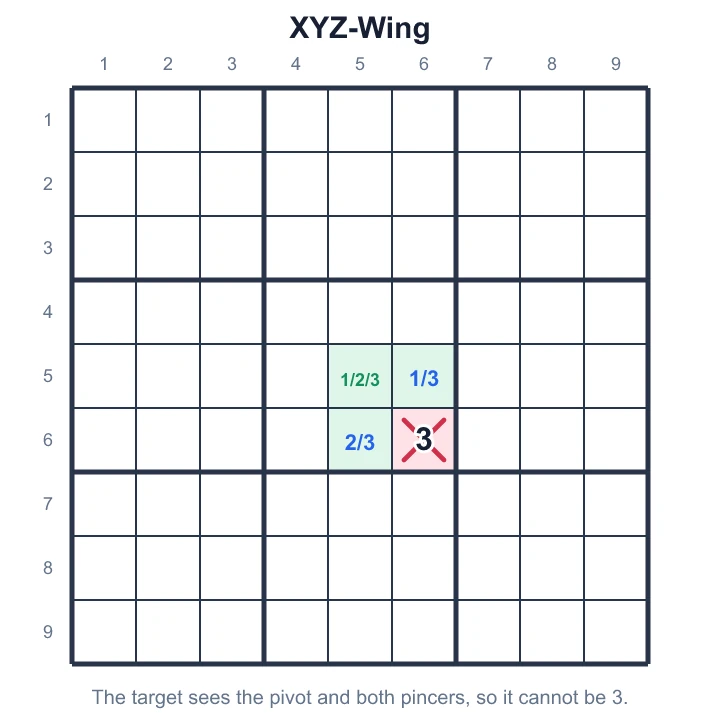
Seeing it. Like an XY-Wing, except the pivot has all three digits. In the diagram, the pivot r5c5 holds 1/2/3, with pincers r5c6 (1/3) and r6c5 (2/3). All three are in the centre box.
Using it. The pivot could be 3 itself, so 3 is in one of the three cells. Only a cell that sees all three can lose its 3. Here that's r6c6, which shares the box with the pivot and both pincers. In practice the targets are almost always inside the pivot's box.
Wings
W-Wing
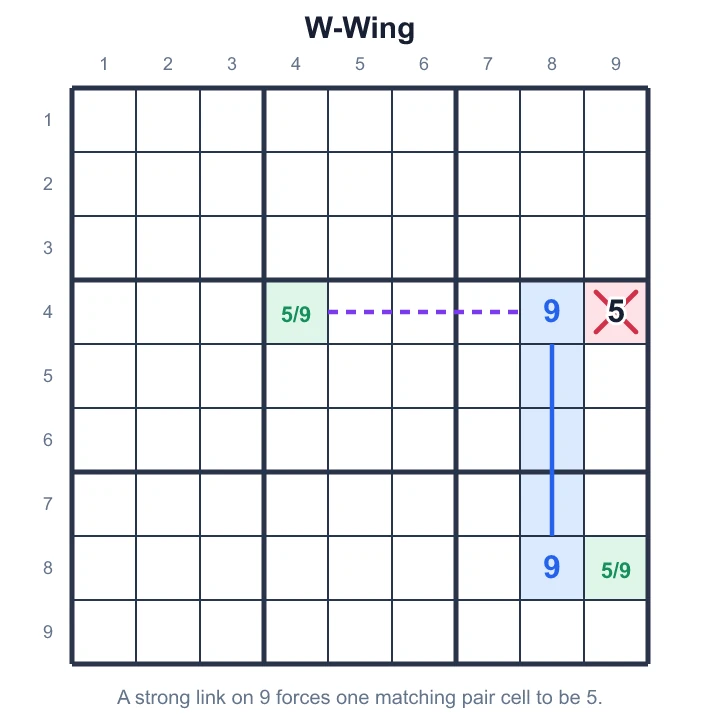
Seeing it. Find two cells with the same pair of candidates that don't see each other. In the diagram these are r4c4 and r8c9, both 5/9. Then look for a strong link on one of the two digits that joins them. Column 8 has 9 only at r4c8 and r8c8. r4c8 sees r4c4 along row 4, and r8c8 sees r8c9 along row 8.
Using it. Column 8's 9 is at r4c8 or r8c8. If it's r4c8, then r4c4 can't be 9, so it's 5. If it's r8c8, then r8c9 is 5. One of the pair cells is 5 either way. Remove 5 from any cell that sees both: r4c9, which shares row 4 with one and column 9 with the other.
Single-digit patterns
Skyscraper
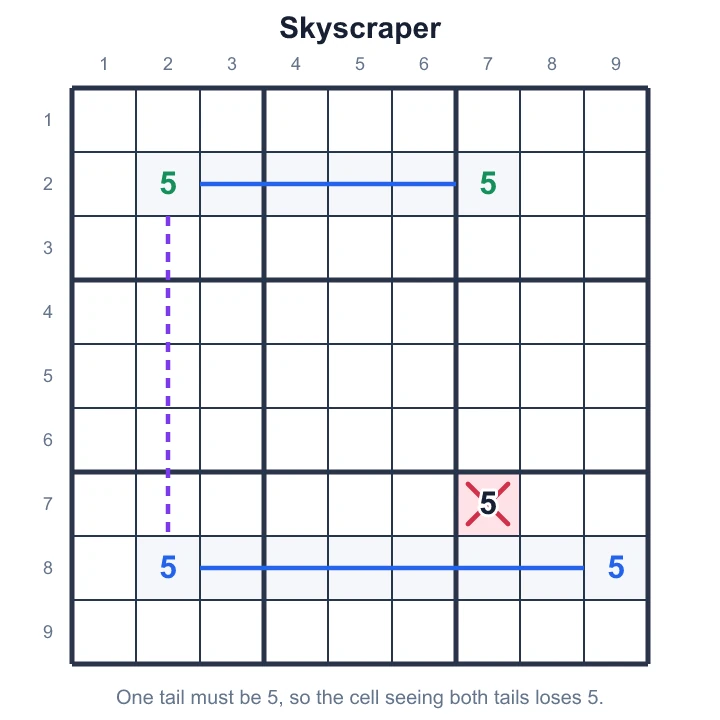
Seeing it. Pick one digit and find two parallel rows where it has exactly two candidates. One end of each lines up in the same column; the other ends don't. In the diagram, 5 appears in row 2 only at columns 2 and 7, and in row 8 only at columns 2 and 9. Column 2 is the shared base. r2c7 and r8c9 are the tails, the tops of the two towers.
Using it. Only one of the two column 2 cells can be 5. If r2c2 isn't 5, r2c7 is. If r8c2 isn't 5, r8c9 is. So at least one tail is 5. Remove 5 from any cell that sees both tails: r7c7 shares column 7 with one tail and box 9 with the other. Eliminations only exist when the tails sit in boxes in the same band or stack, so check that first.
Single-digit patterns
Two-String Kite
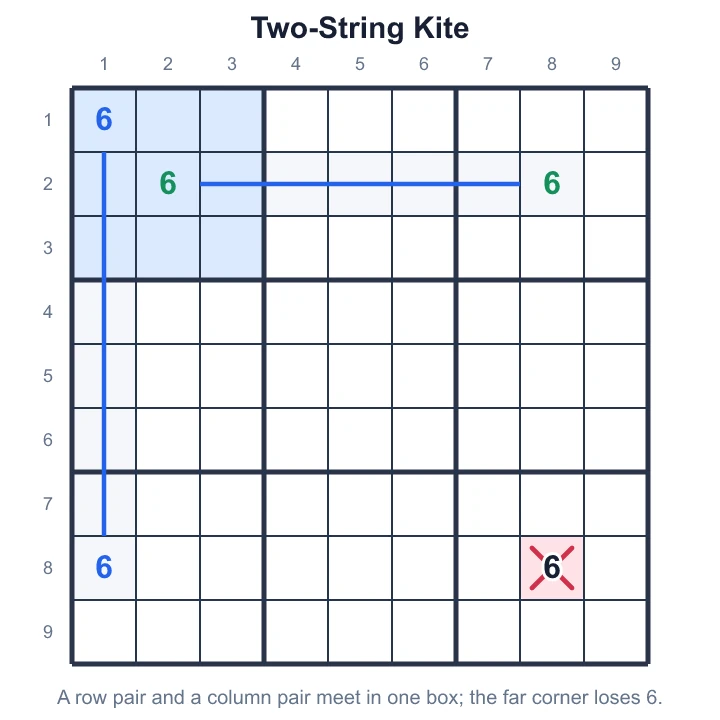
Seeing it. For one digit, find a row with exactly two candidates and a column with exactly two candidates, where one end of each falls in the same box. In the diagram, row 2 has 6 at columns 2 and 8, and column 1 has 6 at rows 1 and 8. r2c2 and r1c1 meet in the top-left box.
Using it. r1c1 and r2c2 share a box, so they can't both be 6. If r2c2 isn't 6, r2c8 is. If r1c1 isn't 6, r8c1 is. So at least one of the two far ends is 6. The cell that sees both, r8c8, can't be 6.
Single-digit patterns
Turbot Fish
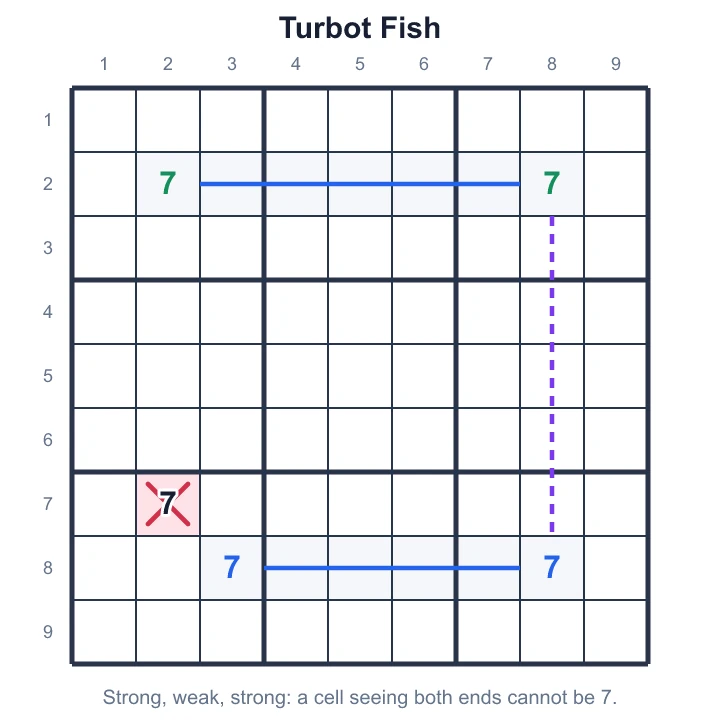
Seeing it. Turbot Fish is the general name for a three-link chain on one digit: strong, weak, strong. Skyscrapers and Two-String Kites are Turbot Fish with particular shapes. In the diagram, row 2 has 7 only at r2c2 and r2c8 (strong). r2c8 and r8c8 share column 8 (weak). Row 8 has 7 only at r8c8 and r8c3 (strong).
Using it. Walk it from one end. If r2c2 isn't 7, then r2c8 is, so r8c8 isn't, so r8c3 is. One of the two ends, r2c2 or r8c3, is 7. A cell that sees both can't be: r7c2 shares column 2 with one end and box 7 with the other.
Single-digit patterns
Empty Rectangle
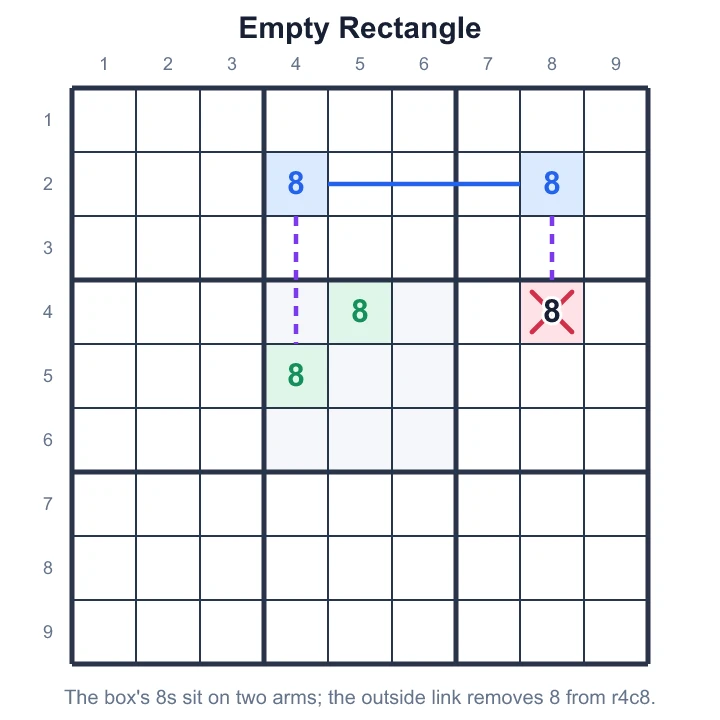
Seeing it. Look in one box at one digit. If all its candidates lie on one row and one column of the box, making a cross or an L, the rest of the box is the empty rectangle. In the diagram, the centre box has 8 only at r4c5 and r5c4, which lie on row 4 and column 4. Then look outside the box for a strong link on 8 with one end on one of those lines. Row 2 has 8 only at r2c4 and r2c8, and r2c4 sits in column 4.
Using it. If r2c4 is 8, column 4 can't have another, so r5c4 is out and the box has to put its 8 on row 4. That rules out r4c8. If r2c4 isn't 8, then r2c8 is, which also rules out r4c8, this time through column 8. Remove 8 from r4c8. The target is always where the strong link's far end lines up with the box's other arm. Work through a couple of examples slowly before relying on this one.