How to solve Killer Sudoku
Killer Sudoku is Sudoku with sums. Its invention is usually credited to the Tokyo puzzle setter Tetsuya Nishio, and it first appeared outside Japan in The Times in 2005. It's also known as Sumdoku and Samunamupure, Japanese for "sum number place".
Start here
The rules
Fill the grid so that every row, every column and every 3×3 box contains each of the numbers 1 to 9 exactly once, as in classic Sudoku.
The grid is also divided into cages, drawn as dashed outlines, and the small number in each cage's corner is its sum. The digits in a cage must add up to that sum, and a digit can't repeat inside a cage.
Most Killer Sudoku start with few or no numbers printed in the grid, so the cages are where you begin.
Basic Killer Sudoku strategies
These five techniques are what make Killer Sudoku different from the classic puzzle: reading what a cage's sum allows, and using the fact that every row, column and box adds up to 45. They're enough to start any puzzle, even one with no numbers printed in the grid.
A few terms first. A cage is a group of cells inside a dashed outline, and its sum is the small number in its corner. A combination is a set of different digits that adds up to a cage's sum. A candidate is a digit that could still go in one cell, the small pencil marks you write in it.
The diagrams use the same grid and colours as our Sudoku pages. Green marks the cells the step is about, blue marks cells it compares them with, grey shades the row, column or box being added up, and red with a cross is a candidate you remove.
The ordinary Sudoku techniques all still work, so after every placement scan its row, column and box for singles as usual. The difference is that you'll often start from the cages, not from printed numbers.
Cage combinations
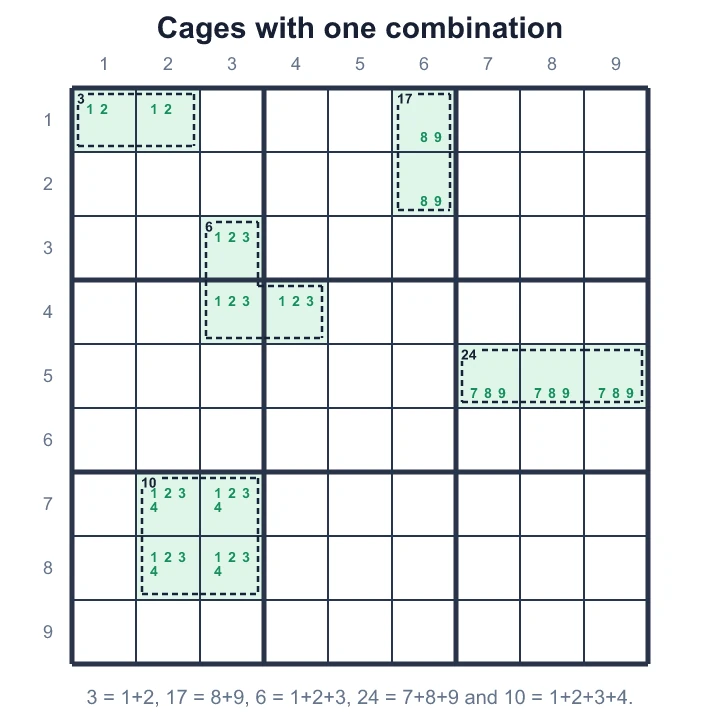
Cages with one combination
Seeing it. Some sums can only be made one way, and these are the ones to learn first. In two cells, 3 is 1+2, 4 is 1+3, 16 is 7+9 and 17 is 8+9. In three cells, 6 is 1+2+3, 7 is 1+2+4, 23 is 6+8+9 and 24 is 7+8+9. In four cells, 10 is 1+2+3+4, 11 is 1+2+3+5, 29 is 5+7+8+9 and 30 is 6+7+8+9.
Using it. Pencil the combination into every cell of the cage. You don't know the order yet, but the digits are fixed, and the rows, columns and boxes the cage touches can't use them anywhere else. The smallest and largest sums for a cage's size are always the single-combination ones, so a very small or very large sum is the first thing to look for.
Cage combinations
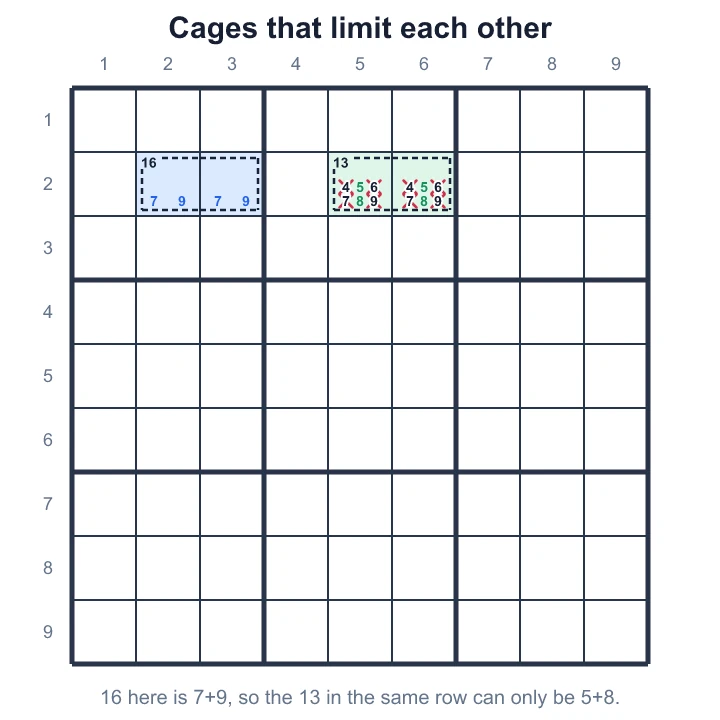
Cages that limit each other
Seeing it. Most cages have a few combinations. List them, then check them against the cages around them.
Using it. Strike out any combination that needs a digit another cage in the same row, column or box has already claimed. In the diagram the 16 is 7+9. The 13 in the same row could be 4+9, 5+8 or 6+7, but 7 and 9 are taken, so 4+9 and 6+7 are both out. That leaves 5+8, and the 13's cells lose 4, 6, 7 and 9.
Cage combinations
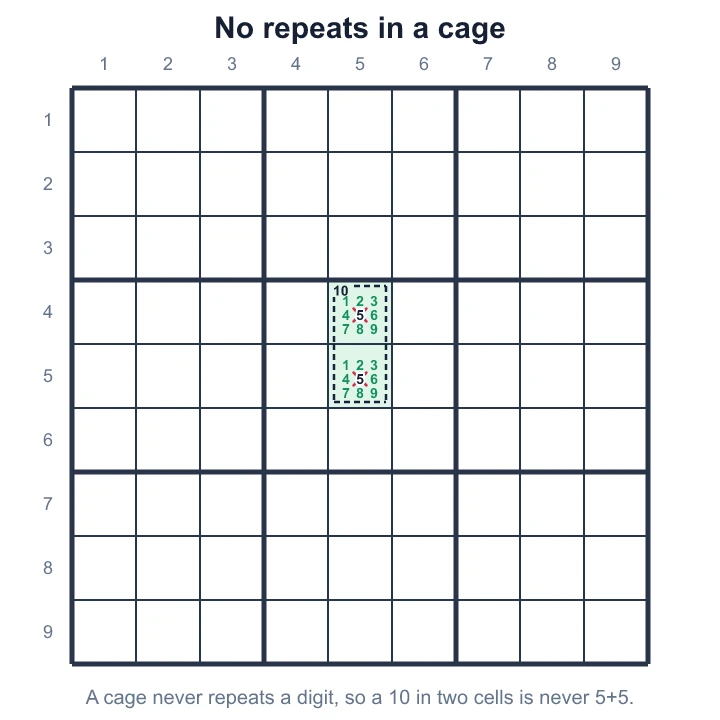
No repeats in a cage
Seeing it. A digit can't appear twice in a cage, even when the cage bends so its cells don't share a row, column or box. (Calcudoku allows that kind of repeat. Killer Sudoku doesn't.)
Using it. Leave out any combination with a repeated digit. A 10 in two cells is never 5+5, so neither cell can be 5. The same goes for 4, 6, 8, 12, 14 and 16 in two cells: the half-way digit is out. A 24 in three cells can't be 9+9+6, which is why it has to be 7+8+9.
The rule of 45
One cell inside
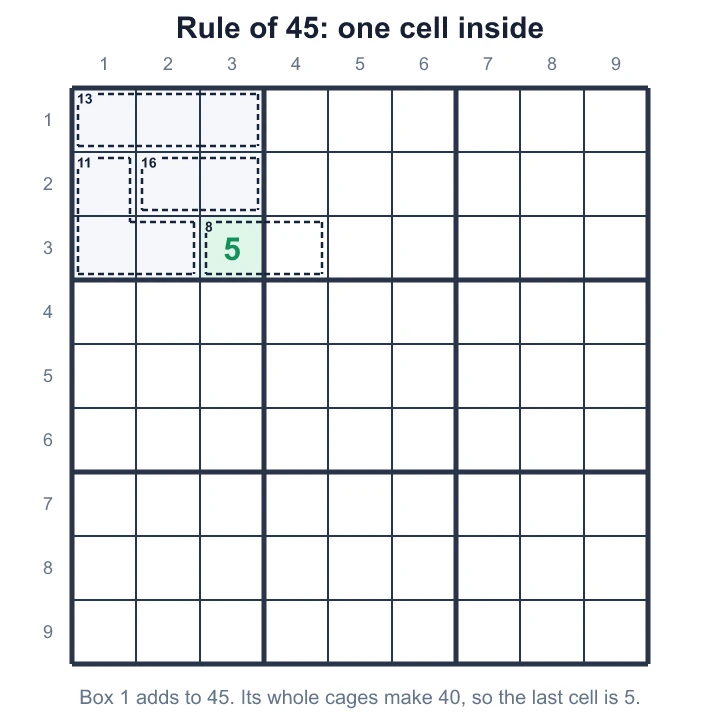
Seeing it. Every row, column and box holds 1 to 9 once, so it always adds up to 45. Look for a row, column or box that is filled with whole cages apart from one cell, which belongs to a cage that reaches outside.
Using it. Add up the whole cages and take the total from 45. What's left is the value of that one cell. In the diagram, box 1's whole cages are 13, 16 and 11, which make 40. The cell left over is 45 − 40 = 5, and its 8 cage then puts 3 next to it. Solvers call this cell an innie.
The rule of 45
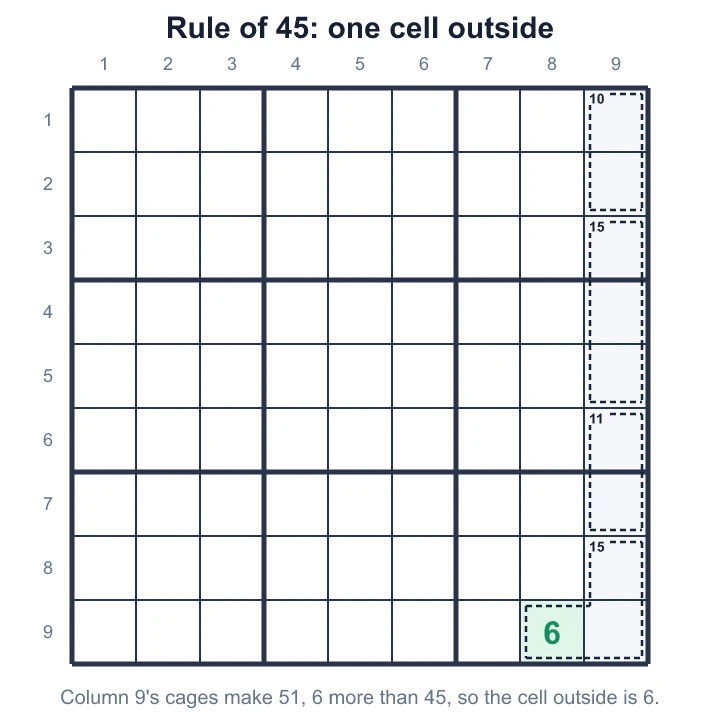
One cell outside
Seeing it. This is the same idea turned round. A set of whole cages covers a row, column or box, and one of their cells sticks out of it.
Using it. Add up the cages and take 45 away. What's left is the cell sticking out, which solvers call an outie. In the diagram the cages down column 9 are 10, 15, 11 and 15, which make 51. That's 6 more than the column needs, so the cell outside the column is 6. Check every row, column and box for innies and outies early: they're often the only way into a Killer with no given numbers.