Advanced Calcudoku strategies
When the cages stop giving numbers away, hard puzzles turn to whole rows and columns. These ten techniques use the fact that every line has the same total and the same product, then bring the row and column logic from Sudoku back in.
Two facts drive most of this page. Every row and column of an N×N grid holds 1 to N once, so it always adds up to the same total: 15 in a 5×5, 21 in a 6×6 and 45 in a 9×9. It also always multiplies to the same product: 120 in a 5×5, 720 in a 6×6 and 362,880 in a 9×9.
The diagrams use the same colours as the basic page. Thick lines are cage borders, green marks the cells the step is about, blue marks the cages or lines being used, purple shows a link between cells, and red with a cross is a candidate you remove.
Line and region totals
Line totals
Seeing it. Look for a row or column that is almost entirely made of whole + cages, with one or two cells left over.
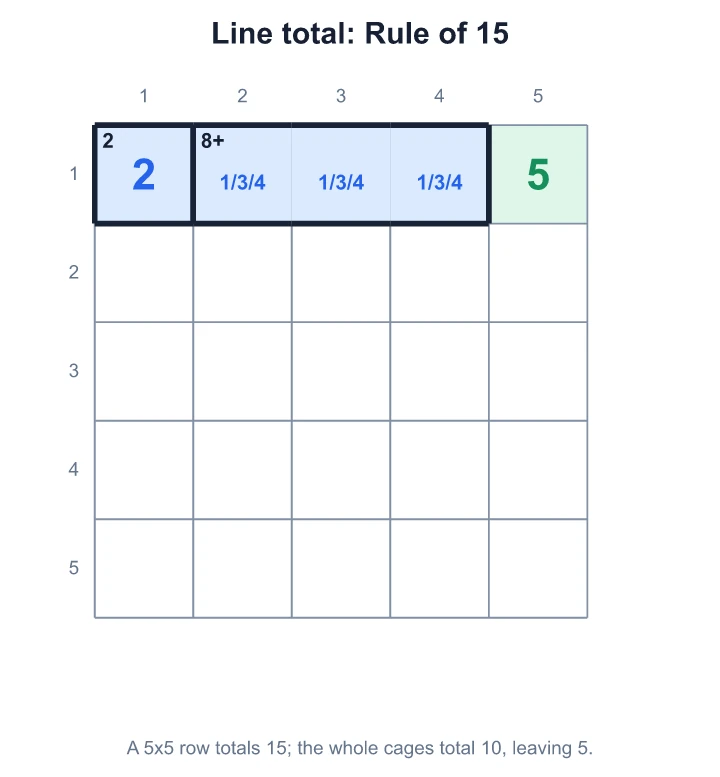
Using it. Add up the whole cages and take the result from the line total. In the diagram, row 1 has a single 2 and an 8+ cage, which come to 10. A 5×5 row adds to 15, so the last cell is 5.
Line and region totals
One cell sticking out
Seeing it. A set of cages covers a whole row or column, and one cell of those cages sticks out of the line. Solvers call this cell an outie.
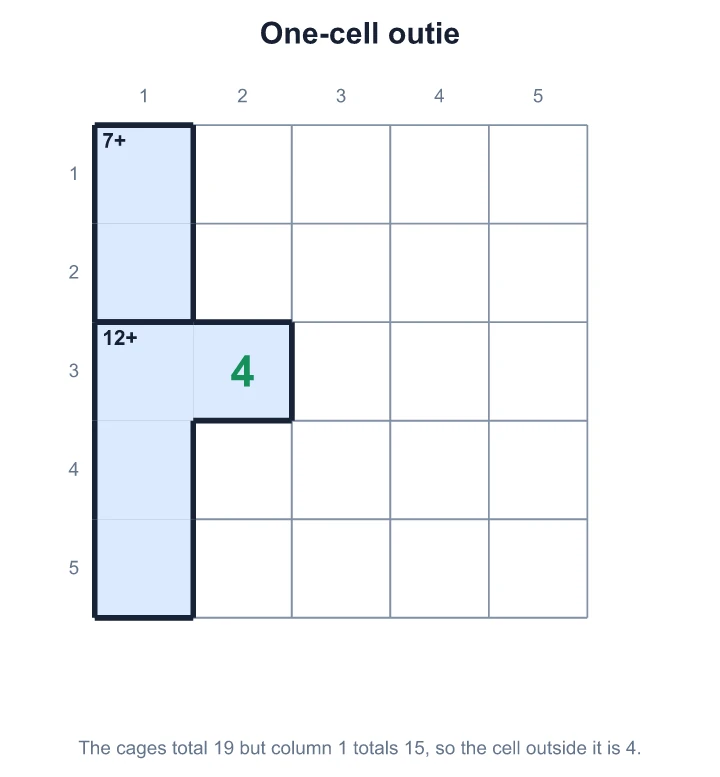
Using it. Add the cages' targets and take away the line total. What's left is the outie. In the diagram, the 7+ and 12+ cages total 19, and column 1 adds to 15, so the cell sticking out is 4.
Line and region totals
Cells left inside a region
Seeing it. Pick one or more neighbouring rows or columns and work out their total. Some cells inside the region may not belong to any cage that sits fully inside it. These are innies.
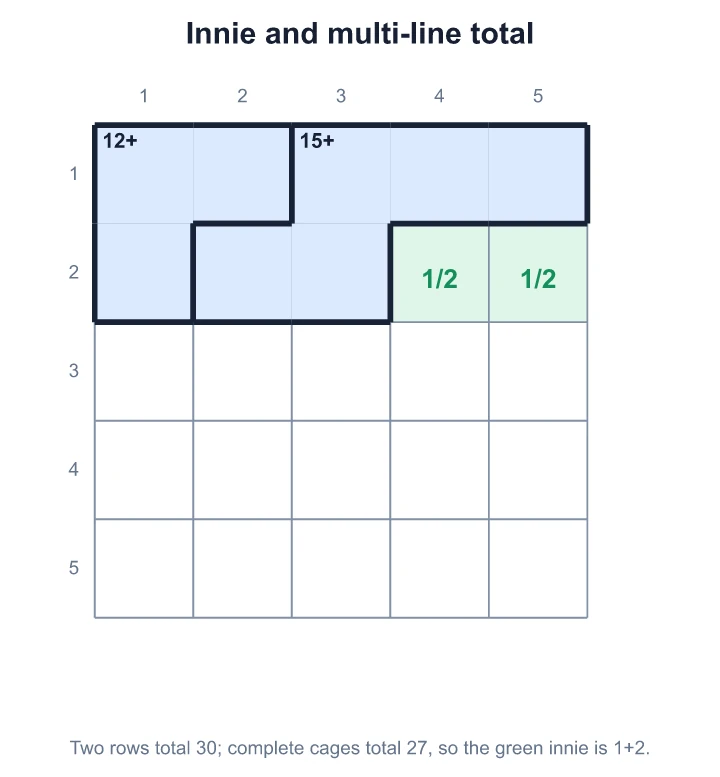
Using it. Take the whole cages' targets from the region's total, and the rest belongs to the innies. In the diagram, two rows of a 5×5 add to 30. The 12+ and 15+ cages account for 27, so the two green cells add to 3. They must be 1 and 2.
Line and region totals
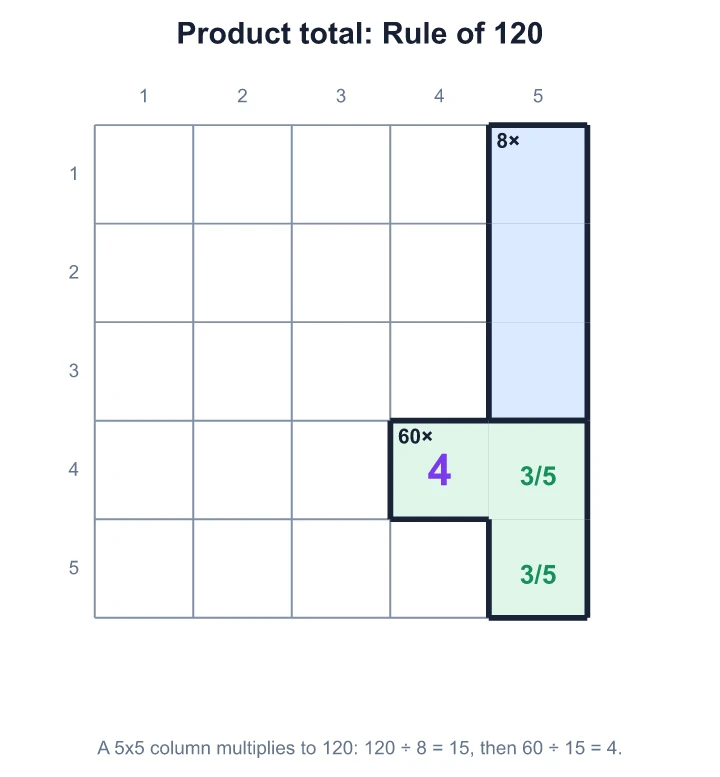
Line products
Seeing it. The same idea works for × cages, using the line's product instead of its total.
Using it. Divide the whole × cages out of the line's product. In the diagram, column 5 multiplies to 120. The 8× cage takes out 8, leaving 15, so the two lower cells of column 5 are 3 and 5. The 60× cage then needs 60 ÷ 15 = 4 in its third cell.
Line and region totals
Odd or even
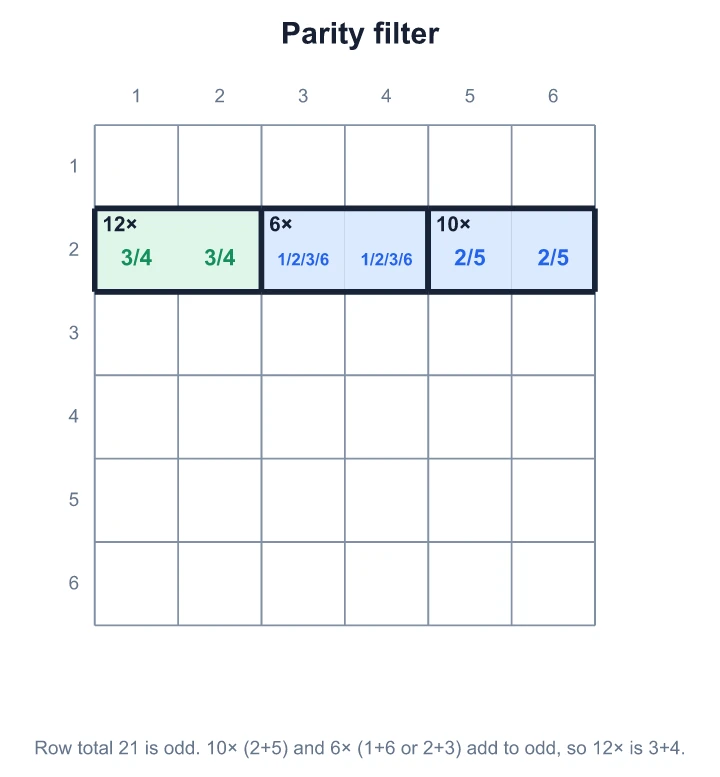
Seeing it. Sometimes you don't know what a cage adds to, but you do know whether it's odd or even. A 6× pair in a 6×6 is 1 and 6 or 2 and 3: the sum is 7 or 5, odd either way.
Using it. A 6×6 row adds to 21, which is odd. In the diagram the 10× pair (2 and 5) adds to 7 and the 6× pair adds to an odd number too. Odd plus odd is even, and 21 minus an even number is odd, so the 12× pair must add to an odd number. That rules out 2 and 6 (8) and leaves 3 and 4 (7). This one takes practice, so save it for when the other totals don't help.
Cages and lines together
A number trapped in a cage
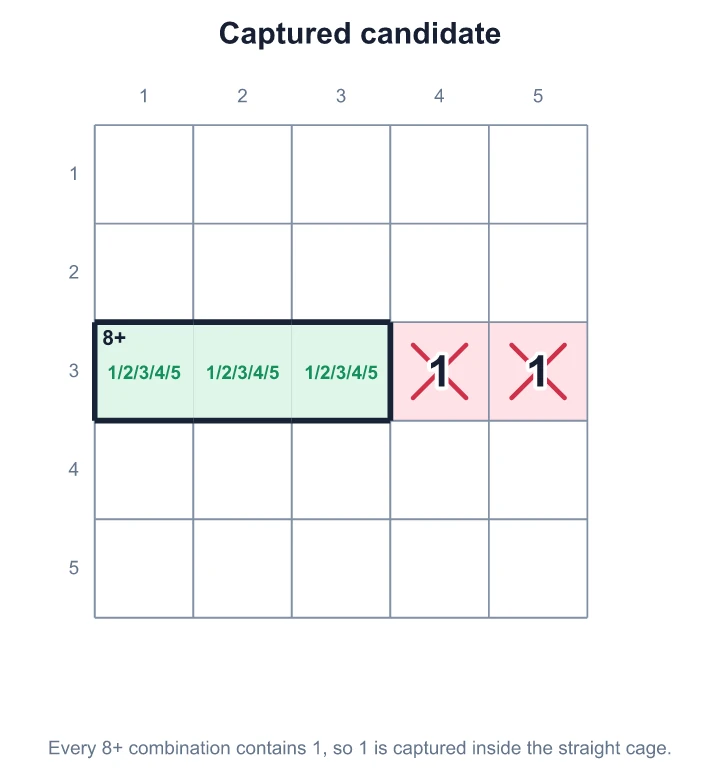
Seeing it. Every combination for a straight cage contains the same number. You don't know which cell it's in, but it has to be somewhere in the cage.
Using it. Cross that number off the rest of the row or column. In a 5×5, a three-cell 8+ cage in one row is 1, 2 and 5 or 1, 3 and 4. Both include 1, so no other cell in row 3 can be 1.
Cages and lines together
A number stuck in one part of a cage
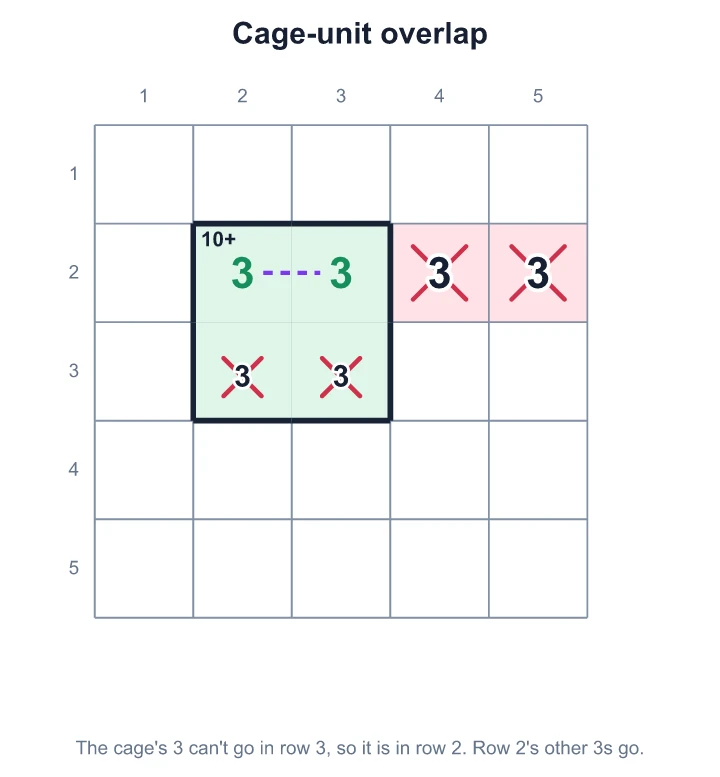
Seeing it. A cage has to contain a certain number, and the only cells left for it all lie in one row or column. This works for bent cages, where the trapped-number trick above doesn't.
Using it. The number must go in that part of the cage, so remove it from the rest of the line. In the diagram, every combination left for the 10+ cage includes a 3, and its row-3 cells have lost 3. The 3 is in row 2, so the other 3s in row 2 go.
Cages and lines together
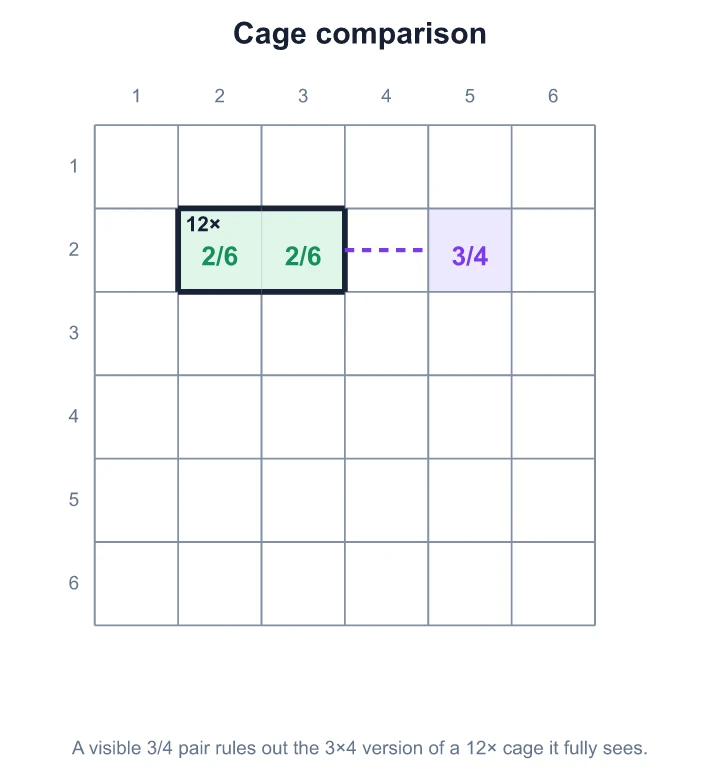
Test one cage against another
Seeing it. One of a cage's combinations would use up the numbers another cell or cage in the same line needs.
Using it. Try each combination and check the cells it affects. If one leaves another cell with nothing, it's wrong. In the diagram, a 12× pair in a 6×6 is 2 and 6 or 3 and 4. A cell further along the row can only be 3 or 4, so if the cage took both, that cell would be empty. The cage is 2 and 6.
Cages and lines together
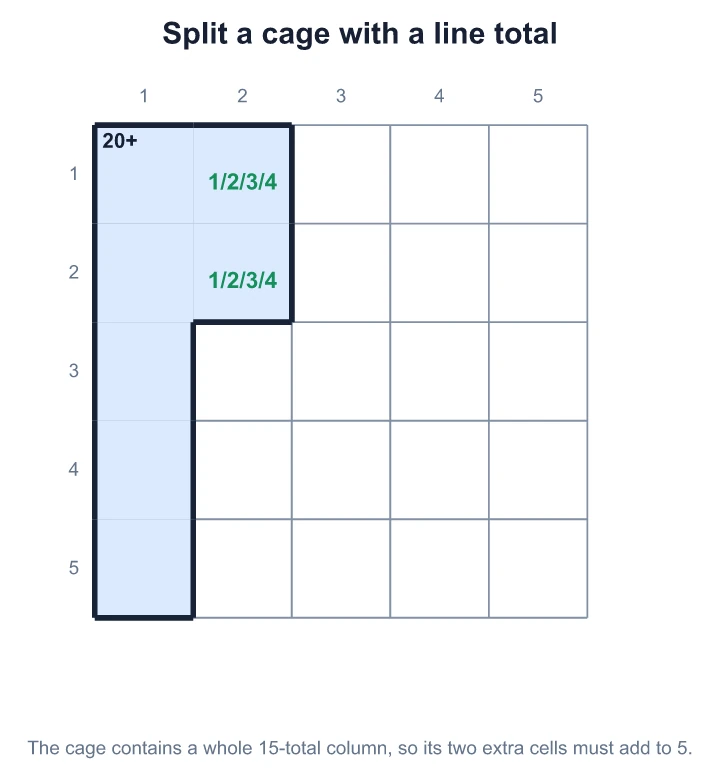
Take a whole line out of a cage
Seeing it. A big + cage contains a complete row or column, plus a few extra cells.
Using it. The complete line adds to its usual total, so take that from the cage's target. What's left is a smaller cage made of the extra cells. In the diagram, the 20+ cage holds all of column 1, which adds to 15, so the two extra cells add to 5: 1 and 4, or 2 and 3.
Row and column logic
Sudoku techniques still work
Seeing it. Every row and column of a Calcudoku holds each number once, just like Sudoku. So the row and column techniques from our Sudoku pages work here too: singles, pairs, triples, X-Wings and chains.
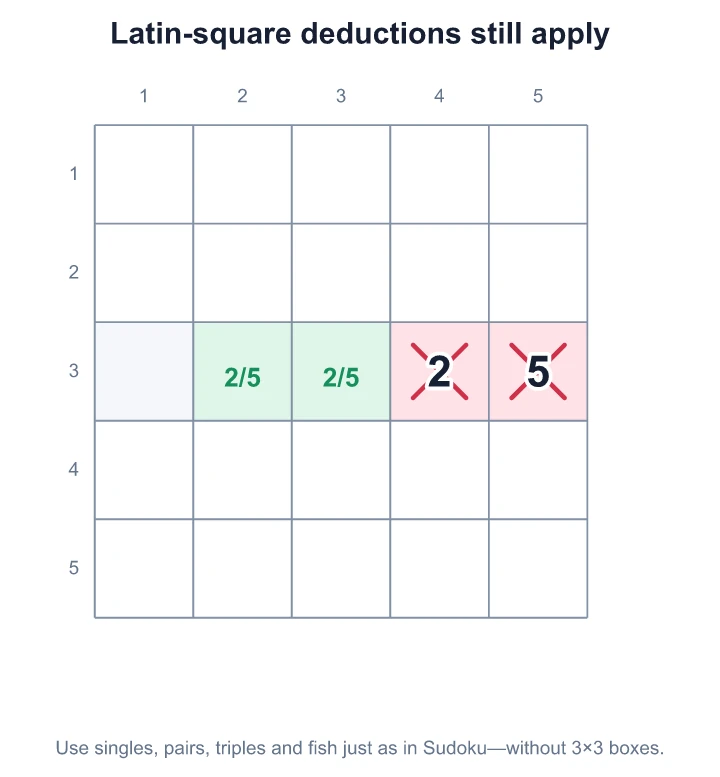
Using it. Ignore anything about 3×3 boxes, since Calcudoku has none. In the diagram, two cells in row 3 can only be 2 or 5, so they take both numbers between them, and 2 and 5 come off the rest of the row. The basic, intermediate and advanced Sudoku strategies explain the rest with diagrams.