
Puzzle types
The difference between Calcudoku and KenKen, explained
23 October 2026
Free, every day
Today's Sudoku: Very Hard
Hard to Extreme. No signup needed.
Short answer: there isn't much of one. Calcudoku and KenKen are the same kind of puzzle under different names. KenKen is a trademark, so everyone who doesn't own it uses Calcudoku or Mathdoku instead. If two books play differently, the cause is the rules that publisher chose, not the name on the cover.
Where the names come from
Tetsuya Miyamoto, a Japanese maths teacher, invented KenKen in 2004 as a puzzle people could pick up without being given instructions. The names KenKen and KenDoku are trademarked, and Wikipedia's KenKen entry says the holder is now Nextoy, LLC. Everyone else says Calcudoku or Mathdoku. One free Calcudoku generator sums it up the same way: three names, one set of rules.
What they share
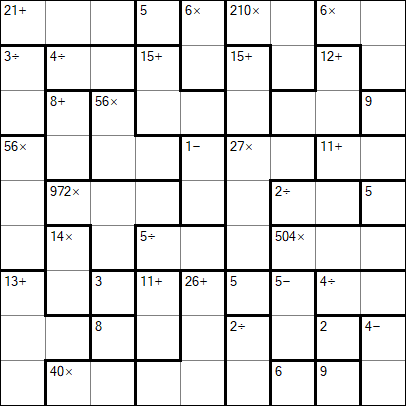
You fill a square grid with the digits 1 up to the grid size, so that no digit repeats in any row or column, just as in Sudoku. Thick lines divide the grid into cages. Each cage carries a target number and an operator (+, −, × or ÷), and the digits inside it must produce that target.
On a 4x4 grid, a two-cell cage marked 3+ must hold 1 and 2, in either order. A cage marked 2÷ holds either 1 and 2, or 2 and 4. A single-cell cage is a gift, because it simply shows you the digit.
One rule surprises people coming from Sudoku: a digit can appear twice in the same cage, as long as the two cells aren't in the same row or column.
Where they can differ
Three things vary from one publisher to the next.
- Subtraction and division cages. In Will Shortz's KenKen books they are limited to two cells. Other authors allow more, working from the largest digit down, so a subtraction cage holding 4, 2 and 1 means 4 − 2 − 1.
- Hidden operators. Harder puzzles can leave the symbol out. The cage shows only a target, and working out whether it's added, multiplied or something else becomes part of the puzzle.
- Grid size. KenKen grids run from 3x3 to 9x9. The ones most people meet in newspapers tend to sit at the small end.
Read the rules at the front of any book before you buy it, because that's where these differences are settled.
Why 9x9 feels different
A 9x9 grid is harder than a 6x6, though not by as much as you might expect when a puzzle uses only one or two operations. It gets much harder when all four operations appear together, switching from one operation to another from cage to cage to reach each target.
The other change is that with a full 9x9 you are going to be using Sudoku techniques more often once you've started placing numbers. The cages get you going, and ordinary Sudoku logic then kicks in to work alongside the cage logic.
That's the character of both our Calcudoku series. Hard Core Calcudoku 500 is all Very Hard and Extreme. 600 Calcudoku climbs through three levels.
Which to try first
If you only know small newspaper grids, start with Novice in 600 Calcudoku, or in the 157 Large Print Calcudoku, where Novice runs from Easy to Hard. The Calcudoku solving guide will get you through the first few cages.