
Puzzle types
Is Futoshiki Japanese? Where the inequality puzzle comes from
20 November 2026
Free, every day
Today's Sudoku
Five levels, Easy to Extreme.
Yes. The name is Japanese: 不等式, pronounced futōshiki, means "inequality". The puzzle is usually credited to a Japanese creator too, though not much has been written about how it started.
Where it came from
Wikipedia's Futoshiki entry says Tamaki Seto developed the puzzle in 2001. One puzzle writer's notes on Futoshiki give the same name and year, and say little else is known about him. If that's right, Futoshiki is only a couple of decades old.
It travelled well. Wikipedia lists British newspapers that carry it, including The Times, The Guardian, The Daily Telegraph and the i. It also goes by the name More or Less, which describes it neatly.
The rules in four lines
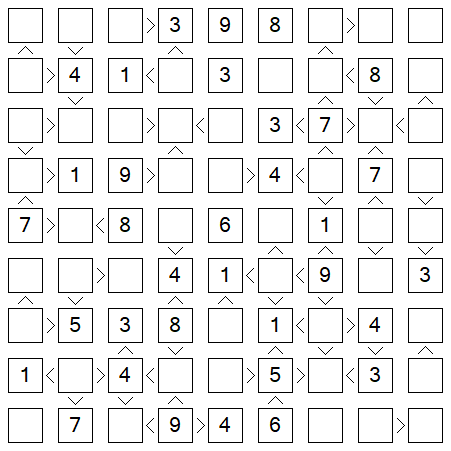
- Fill the square grid so that each row and column contains each digit once, from 1 up to the size of the grid.
- Some digits are given at the start.
- Greater-than and less-than signs sit between some neighbouring squares.
- Every sign must be true when the grid is finished.
That's all. A finished Futoshiki is a Latin square, a Sudoku without the boxes.
Why chains make it addictive
The signs team up. Suppose three squares in a row of a 5x5 grid are linked as a < b < c. Then a can't be bigger than 3, c can't be smaller than 3, and b has to sit between 2 and 4. One chain of three signs has already cut the options in half.
Good puzzles are full of these little cascades. You make one deduction, it clears space for another, and eventually the whole grid runs downhill. It's the same pleasure as Sudoku, delivered in a different way.
How it compares
Sudoku gives you boxes. Calcudoku gives you cages and arithmetic. Futoshiki gives you only signs, so there's no sum to do and no box to scan. If you find arithmetic tiresome but like the logic of Sudoku, this is a good place to go next.
Our Futoshiki solving guide covers the techniques. For puzzles, 600 Futoshiki is graded in three rising levels, and Hard Core Futoshiki 400 is all hard puzzles for experienced solvers.