
How to solve Futoshiki
Futoshiki is a logic puzzle from Japan whose name means "inequality". It was developed by Tamaki Seto and first published in 2001. In the west it has also appeared as "More or Less" and "Hutosiki".
Solving it combines the row and column techniques from our Sudoku guide with a few techniques that use the inequality signs. The examples below use a 7×7 grid.
The rules
Fill the grid so that every row and every column contains each number once, from 1 up to the size of the grid (1 to 7 in a 7×7 puzzle). There are no boxes.
Some neighbouring squares have an inequality sign between them, and every sign must be true. The larger number is always on the open side of the sign and the smaller number on the pointed side. This holds whether the sign runs across a row (< or >) or up and down a column (^ or v).
The two numbers don't have to be consecutive: 9 > 1 is just as correct as 5 > 4.
Smallest and largest values
A square on the pointed side of a sign can never hold the largest number, and a square on the open side can never hold 1. Next to a given number this can solve a square straight away.
- A square that must be smaller than 2 can only be 1.
- A square that must be bigger than 6 (in a 7×7 grid) can only be 7.
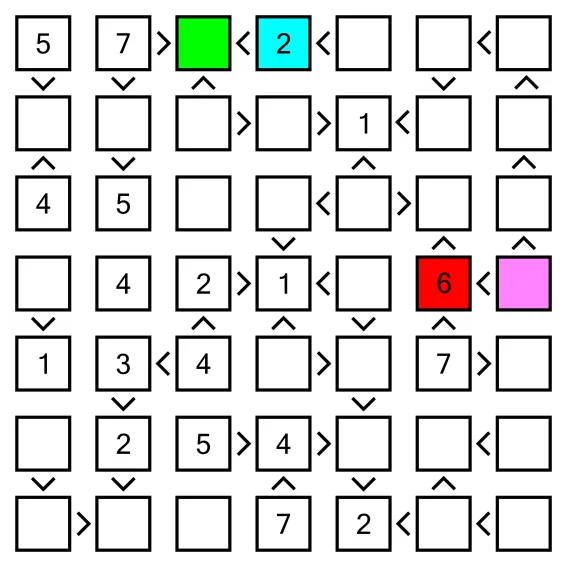
In the example, the green square is smaller than the 2 beside it (blue), so it's 1. The pink square is bigger than the 6 next to it (red), so it's 7.
Ruling out the extremes
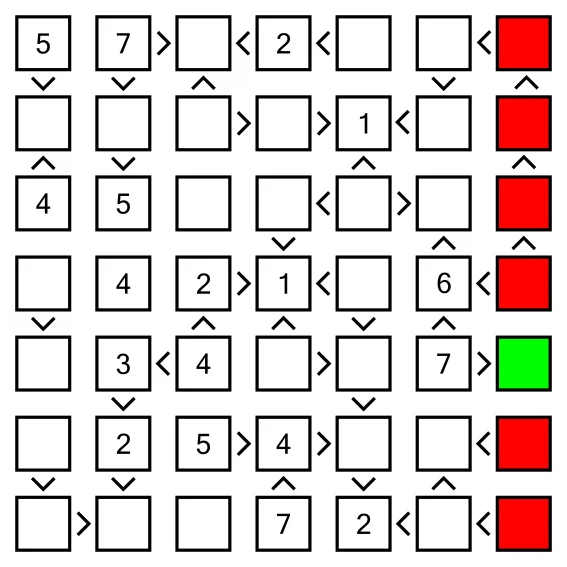
Go along a row or column and ask where the 1 can go. Any square that is bigger than a neighbour can't be 1. Do the same for the largest number: any square that is smaller than a neighbour can't hold it. When only one square in the line is left, the number goes there.
In the example, every red square in the right-hand column is bigger than one of its neighbours, so none of them can be 1. The only square left for the column's 1 is the green one.
Chains of inequalities
Look for chains of squares joined by signs that all point the same way, so each square is bigger than the one before. The chain doesn't have to be straight: it can turn corners between rows and columns.
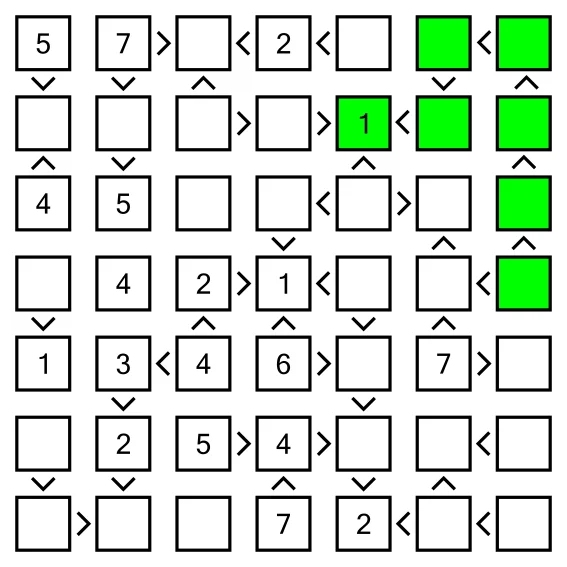
Along a chain the numbers must change by at least one at every step, so a long chain from a given number leaves very little choice. If you see 4 > ? > ? > ?, the three missing numbers must be 3, 2 and 1.
In the example, the chain starts at the given 1 and climbs through six more squares (green), turning from the row up into the top row and then down the right-hand column. That's seven squares, each bigger than the last, in a grid that only goes up to 7. So the chain must be exactly 1, 2, 3, 4, 5, 6, 7 and all six squares are solved at once.
Combine with row and column logic
Once the signs have narrowed things down, switch to the row and column techniques. Look for squares with only one possible number left (sole candidates), numbers that fit in only one square of a row or column (unique candidates), and pairs of squares sharing the same two candidates (naked pairs). Each new number usually makes another sign useful, so keep switching between the two.
All of these are explained with examples in our Sudoku solving guide. Ignore the parts about 3×3 boxes, which Futoshiki doesn't have.