
Puzzle types
Hashiwokakero rules: how to build bridges without crossing
30 October 2026
Free, every day
Today's Sudoku: Extreme
Hard to Extreme. No signup needed.
Hashiwokakero (橋をかけろ) is Japanese for roughly "build bridges!", and that is the whole puzzle. You get numbered islands and you join them up. There's no arithmetic beyond counting to eight, which makes it one of the easiest puzzles in the world to learn and one of the harder ones to finish.
It was published by Nikoli, the Japanese puzzle company. According to Wikipedia it appeared in issue 31 of their magazine in September 1990. Atlas Obscura adds that a reader with the pen name "Lenin" created it, and that its first title was "Atomic Bonding", because the circles and links look like a chemistry diagram. English-language books often call it Hashi or Bridges.
The rules
- Bridges run in straight lines, horizontally or vertically.
- A bridge can't cross another bridge or pass through an island.
- At most two bridges can join any pair of islands.
- The number on an island is how many bridges touch it.
- When you finish, every island is part of one connected network.
A 7x7 example
Here is a small puzzle. Try it before you look at the solution.
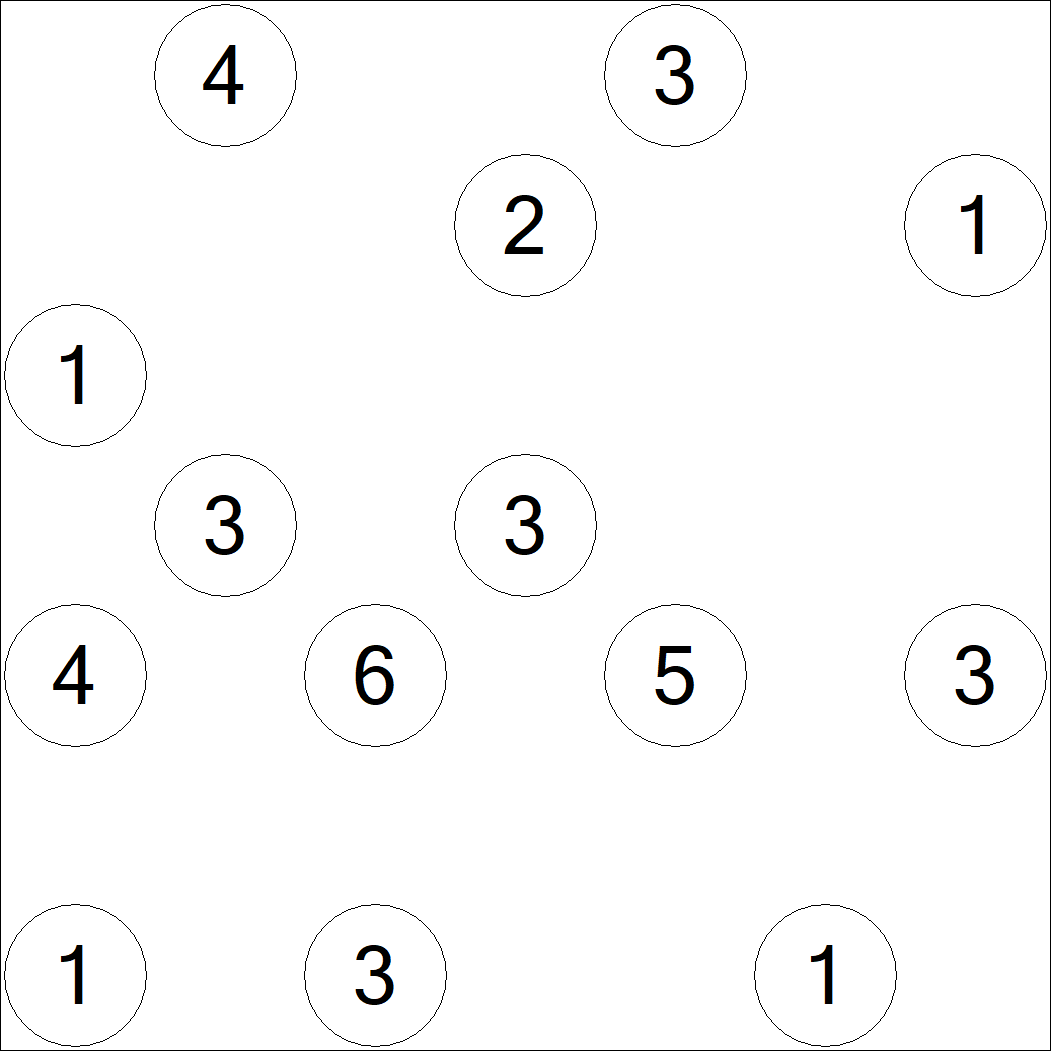
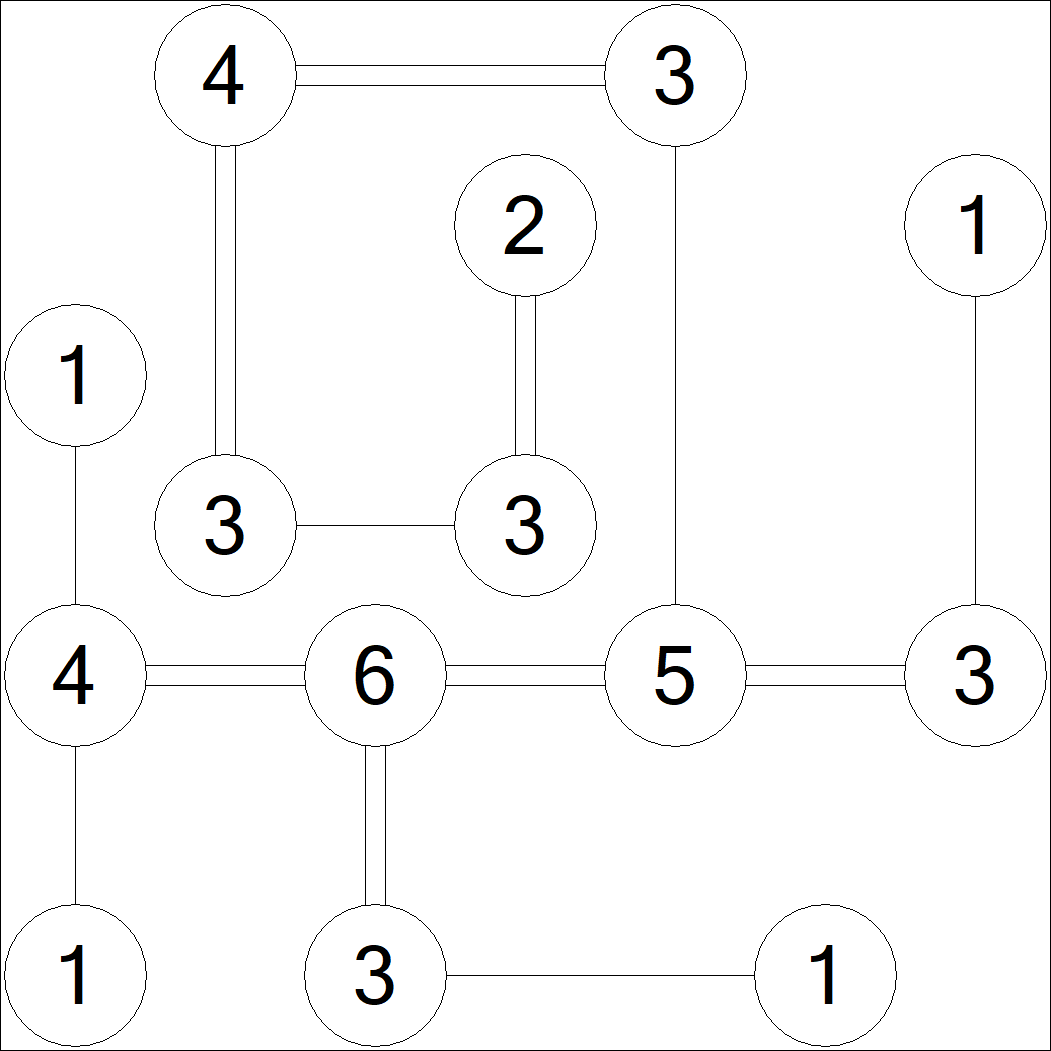
Two islands give themselves away. The 6 in the lower half has only three neighbours: an island to its left, one to its right and one below it. Nothing sits above it. Each neighbour can take at most two bridges, and three times two is six, so all three connections are double.
The 4 on the top row has just two neighbours, the 3 to its right and the 3 below it. Two neighbours at two bridges each makes four, so both of those are double as well. Those few bridges make the rest of the grid fall into place.
Why big grids are hard
The trouble with a large Hashi is that a mistake can sit quietly for a long time. A wrong bridge in one corner contradicts nothing until your network grows far enough to reach the other side of the grid. By then you're many moves past the error.
That's why our Hard Core Hashiwokakero 200 grows from 12x12 up to giant 30x30 puzzles. There is also some mathematics behind the difficulty. Daniel Andersson proved in 2009 that deciding whether a Hashiwokakero puzzle has a solution is NP-complete, which means no one knows a fast method that works for every size of grid. A 7x7 won't trouble you. A 30x30 is another matter.
Where to go next
The Hashiwokakero page has all our books. You'll find free puzzles available in our Bonus Packs. For bigger print, 180 Large Print Hashi (Bridges) starts Novice at 9x12 and reaches 21x28 at Master. Solving tips for every level are collected in our guides.