How to solve Jigsaw Sudoku
Jigsaw Sudoku, also called Irregular Sudoku or Nonomino Sudoku, replaces the 3×3 boxes with nine irregular regions. The regions are the part to learn: they decide where a digit can and can't go, and they cut across rows and columns in ways boxes never do.
Start here
The rules
Fill the grid so that every row, every column and every one of the nine thick-bordered regions holds the digits 1 to 9 once each.
Each region is nine cells joined edge to edge. There are no 3×3 boxes.
Jigsaw Sudoku strategies
These six techniques are for the irregular regions. Everything in How to solve Sudoku still applies, with each region counted wherever you'd count a box. Take care with unique rectangles: a rectangle is only a deadly pattern if each region holds none of its corners, or two that share a row or column.
A few terms first. A region is one of the nine irregular shapes, each made of nine cells joined edge to edge. In the diagrams the thick lines are the region borders, and the region a step is about is tinted grey. The last two techniques use leftovers: the cells a region and a row don't have in common.
The diagrams use the same colours as our other guides. Green marks the cell the step is about and the answer it gives you. Blue marks the cells it depends on. Purple marks the cells you're scanning. Red with a cross is a candidate you can remove.
There are no 3×3 boxes here, so don't look for them. If you lose track of a region's shape, trace its border with a coloured pencil.
Singles in a region
Count the region too
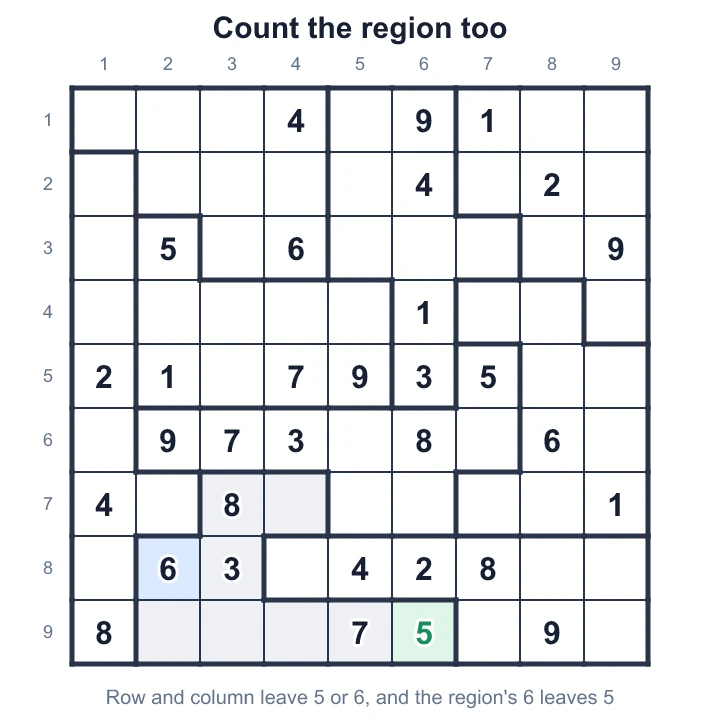
Seeing it. A cell's candidates are what's left after its row, column and region. The region is the one that gets forgotten, because its shape is odd and you can't take it in at a glance. In the diagram, the green cell is row 9, column 6, and its row and column leave 5 or 6.
Using it. Now follow the region right out to the end of its furthest arm. It already has a 6, in row 8, column 2, so the green cell must be 5. When you list candidates for a cell, always walk the whole shape.
Regions and lines
A region along a row or column
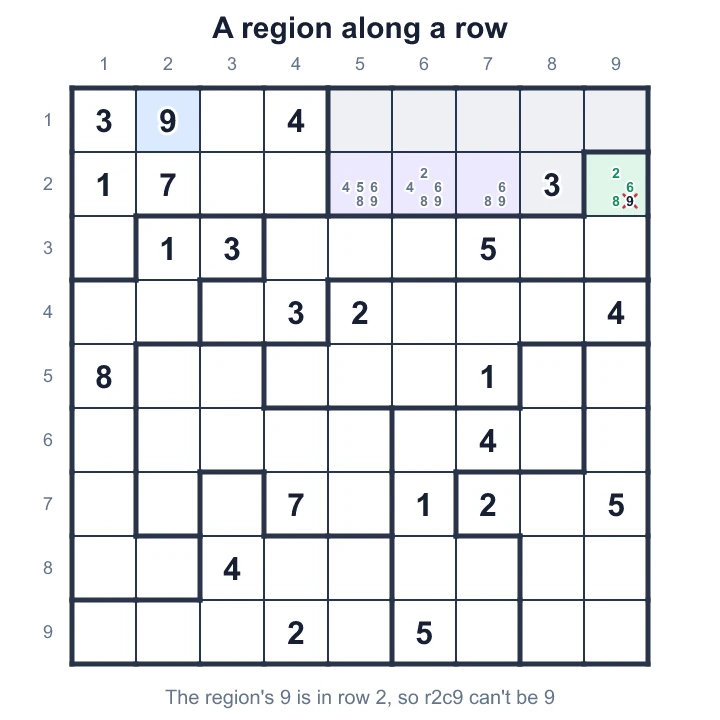
Seeing it. A box has at most three cells on any line, but a region can have many more. Look for a digit whose only places in a region are all on one row or one column. In the diagram, the 9 in row 1 rules out the grey region's cells there, and the 9 can only go in row 2, columns 5, 6 or 7.
Using it. The region's 9 is on row 2, so row 2's 9 is one of those three cells. Remove it from the rest of the row. Here that's the green cell, row 2, column 9.
Regions and lines
A row or column that points into a region
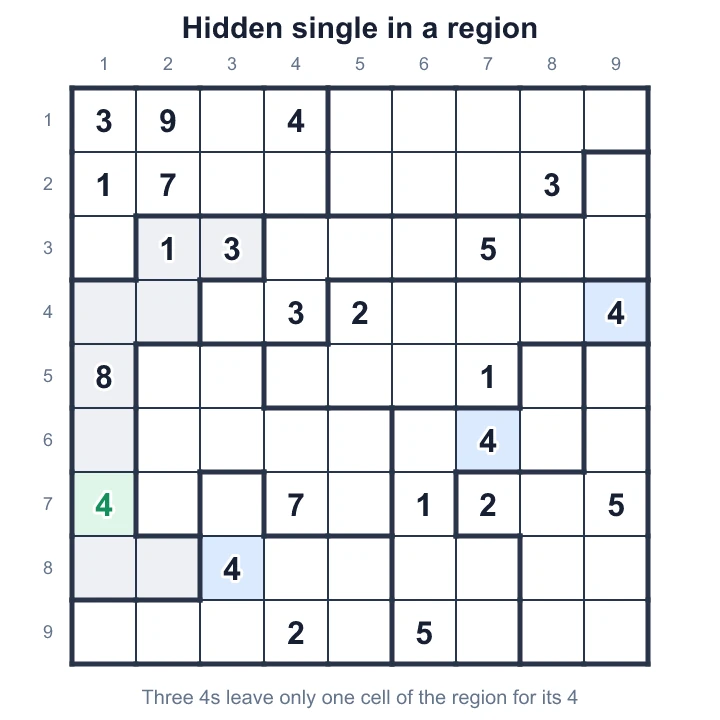
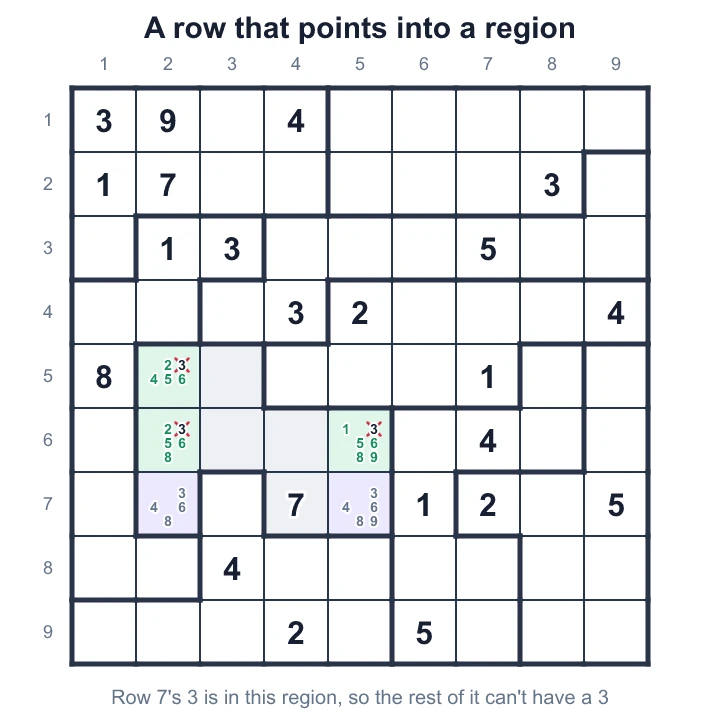
Seeing it. Now turn it round. Look for a row or column whose only places for a digit are all in the same region. In the diagram, row 7 can only take 3 in row 7, column 2 or row 7, column 5, and both belong to the grey region.
Using it. Row 7's 3 is in that region, so the region's 3 is too, and no cell of the region outside row 7 can be 3. Three cells lose it here: row 5, column 2, row 6, column 2 and row 6, column 5. A line crosses several regions, so run the same check for each region it passes through.
Leftovers
Twin cells
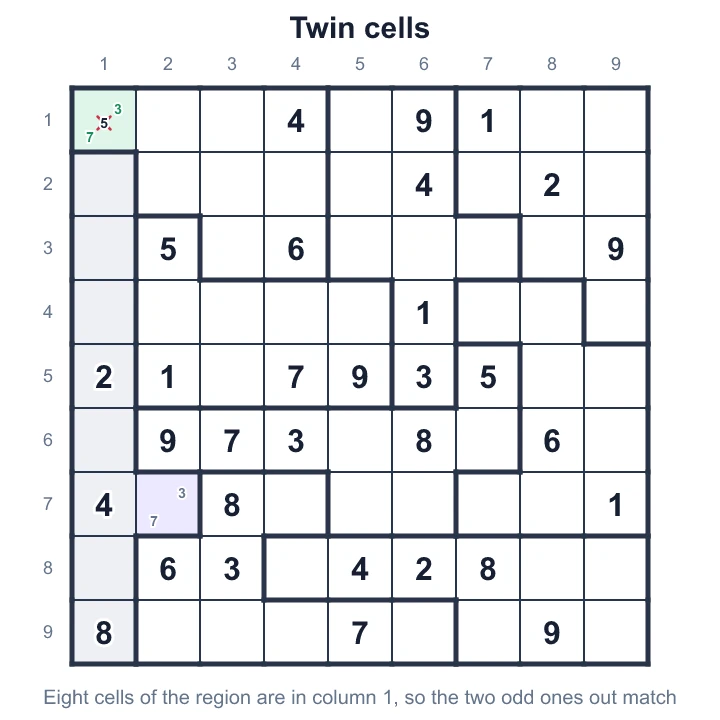
Seeing it. A row and a region both hold 1 to 9. If they share eight cells, those eight hold the same eight digits in both, so the two cells left over must hold the same digit. Look for a region with eight of its nine cells in one row or one column. In the diagram, the grey region has eight cells in column 1. Its ninth cell is row 7, column 2, and the ninth cell of column 1, which belongs to another region, is row 1, column 1.
Using it. The two cells are twins. Once you know one, write the same digit into the other. Until then, each can only be a digit the other can be, so cross out any candidate that isn't in both. Row 7, column 2 can be 3 or 7, and row 1, column 1 can be 3, 5 or 7. The 5 goes, and both cells are 3 or 7.
Leftovers
Leftovers that share their digits
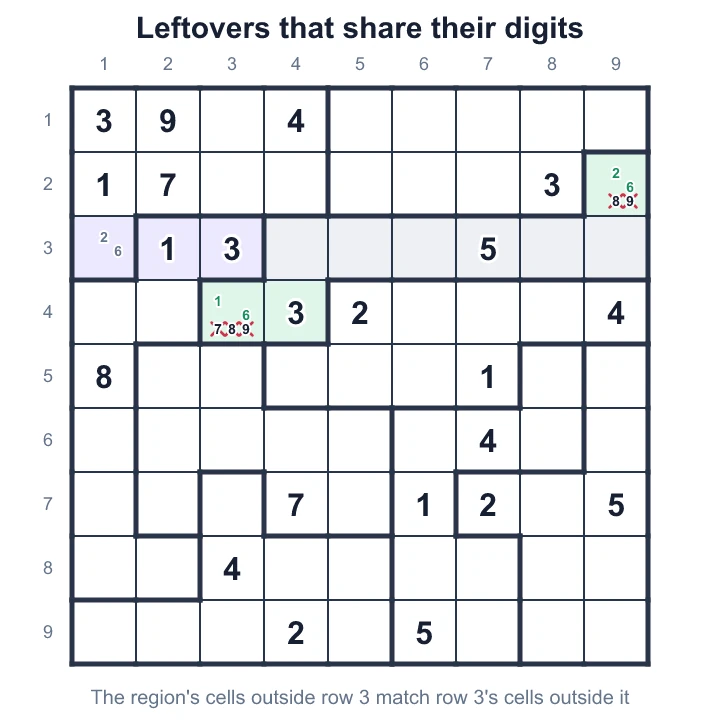
Seeing it. It's the same idea with more cells. Cover the cells a row and a region have in common, and the cells that remain in each hold the same digits, once each. Look for a region with most of its cells in one row or column. Its few cells outside the line are one group of leftovers, and the line's few cells outside the region are the other. In the diagram, the grey region's cells outside row 3 are row 2, column 9, row 4, column 3 and the 3 in row 4, column 4. Row 3's cells outside the region are row 3, column 1 and the 1 and 3 in columns 2 and 3.
Using it. Both groups hold the same digits, so a candidate that appears in one group and nowhere in the other can go. The 3 is in both groups, so take it away. Row 2, column 9 and row 4, column 3 now hold the same digits as the 1 and row 3, column 1, and that cell can only be 2 or 6. So the pair can only hold 1, 2 or 6. That takes 8 and 9 out of row 2, column 9, and 7, 8 and 9 out of row 4, column 3.
It works for two rows or two columns too, against any two regions. The cells of the two regions that sit outside the two rows hold the same digits as the cells of the two rows that sit outside the two regions, each digit counted as many times as it appears. Three works as well, but beyond that the groups get too big to help. The rows have to be all rows or all columns.