How to solve Even-Odd Sudoku
Even-Odd Sudoku is ordinary Sudoku with some cells marked as even or odd. Every row, column and box holds exactly four even digits and five odd ones, which turns the marks into counting.
Start here
The rules
Fill the grid so that every row, every column and every 3×3 box holds the digits 1 to 9 once each.
In Even-Odd Sudoku, a square holds an even digit and a circle holds an odd one. Cells with no mark can hold either.
Even-Odd Sudoku strategies
These five techniques put the squares and circles to work. Everything in How to solve Sudoku still applies.
A few terms first. A square marks an even digit, so it can only be 2, 4, 6 or 8. A circle marks an odd digit: 1, 3, 5, 7 or 9. A cell with no mark is plain and can be either. Every row, column and box holds four even digits and five odd ones, always, and most of the techniques below come from that count.
The diagrams use the same colours as our other guides. Green marks the cell the step is about and the answer it gives you. Blue marks the cells it depends on. Purple marks the cells you're scanning. Red with a cross is a candidate you can remove.
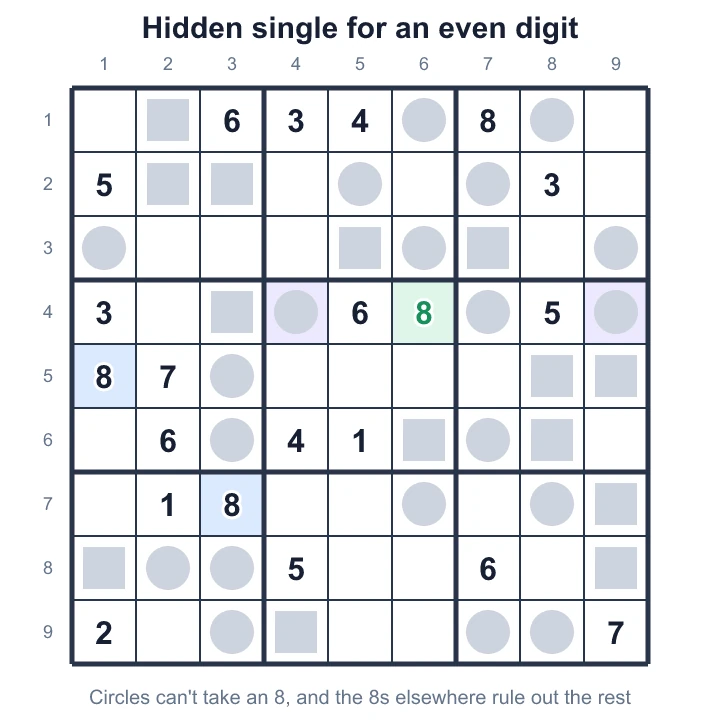
Start by crossing the wrong digits out of every square and circle, and pencil a small E or O in any plain cell once you've worked out which it must be.
Short candidate lists
Squares and circles are solved sooner
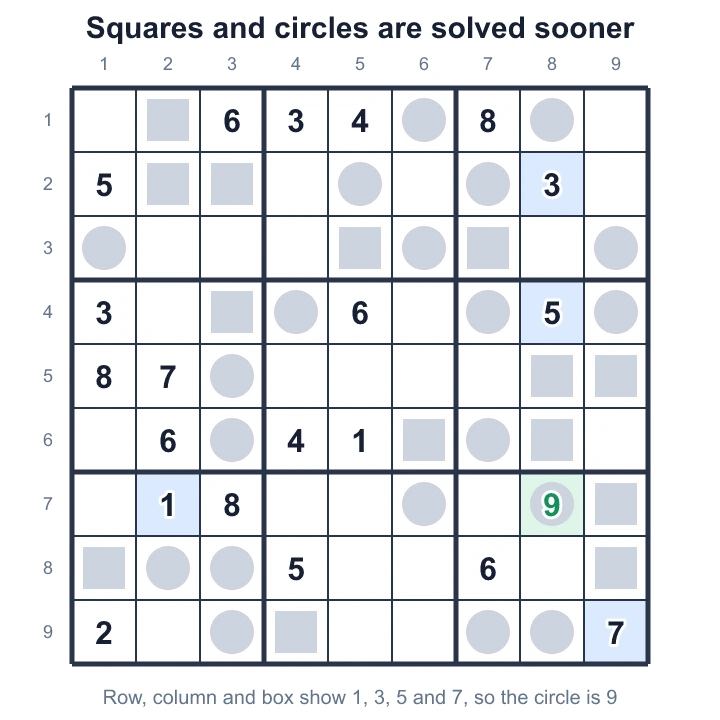
Seeing it. A square has only four candidates and a circle has five, so they're often solved long before a plain cell would be. A square is solved when its row, column and box between them show three of the four even digits. A circle needs four of the five odd ones. A plain cell needs eight different digits. In the diagram, the green cell, row 7, column 8, is a circle.
Using it. Look at what its row, column and box already hold. They show 1, 3, 5 and 7, marked blue, so the green cell is the fifth odd digit, 9. Go round every square and circle this way first. Each one you solve shortens the lists of the cells around it.
Counting squares and circles
Count the squares and circles in a unit
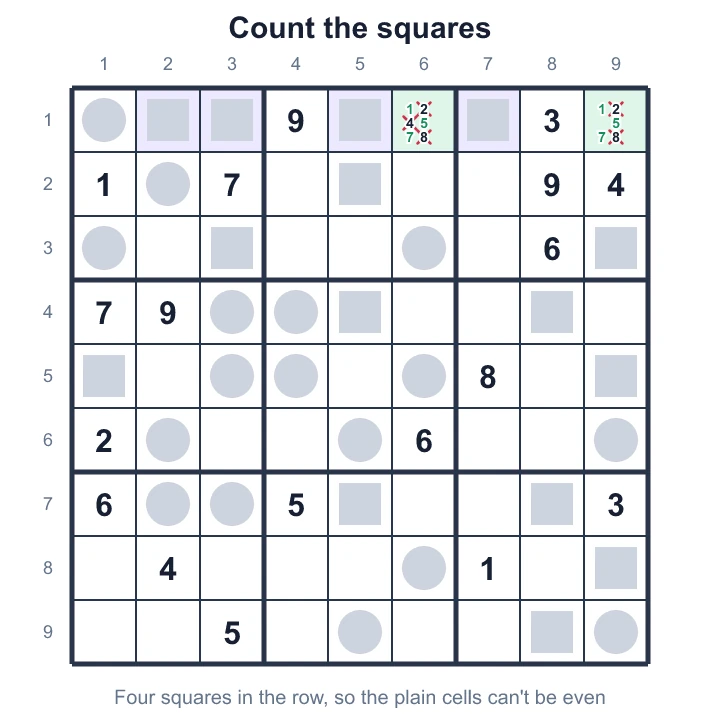
Seeing it. Every unit has four even digits and five odd ones. Count the even digits you can see in the unit: the squares, plus any even digits already placed. Four even digits means they're all used up, and five odd ones means the same for the odds. In the diagram, row 1 has four squares, marked purple.
Using it. With four evens, every plain cell left in the unit is odd. With five odds, every plain cell is even. The green cells, row 1, column 6 and row 1, column 9, lose their even candidates. Each plain cell is in three units, so check all three. If any one of them forces the cell to be odd, it only has odd candidates left.
A unit with one plain cell left is a special case. The cell takes whatever parity is missing: even if the other eight cells include three evens, odd if they include four.
Counting squares and circles
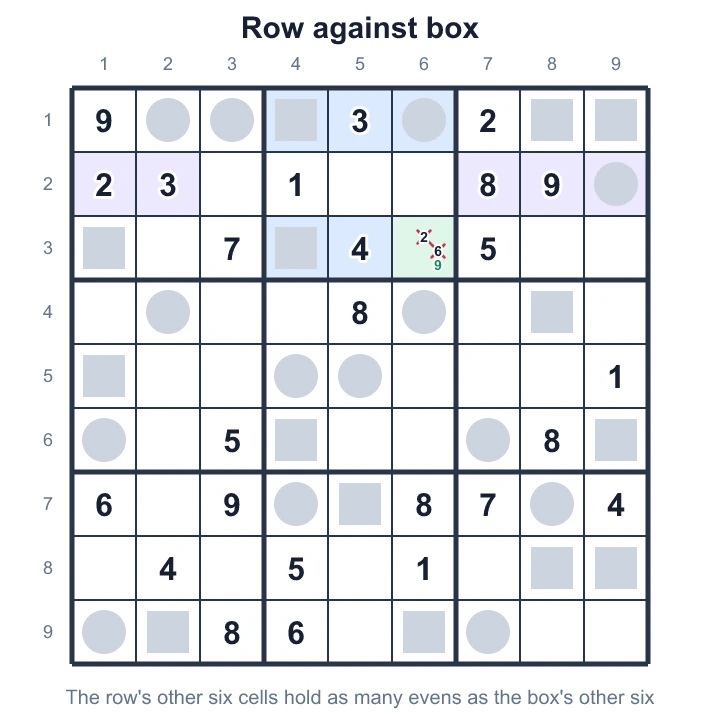
Row against box
Seeing it. A row and a box share three cells. Take those away and each has six cells left. The row had four even digits to begin with, and so did the box, so the six cells left in the row hold as many even digits as the six left in the box. A column against a box works the same way. In the diagram, the six row cells are purple and the six box cells are blue and green.
Using it. Count the even digits you can see in each set, then ask what the plain cells have to be. Row 2's six cells show two even digits, the 2 and the 8, and one plain cell, so the row has two or three. The box's six cells show three, two squares and the 4, and one plain cell, so it has three or four. The two counts must match, so each has three. The green cell, row 3, column 6, is odd and loses its 2 and 6. Row 2's plain cell is even.
Groups
Pairs and triples among the squares
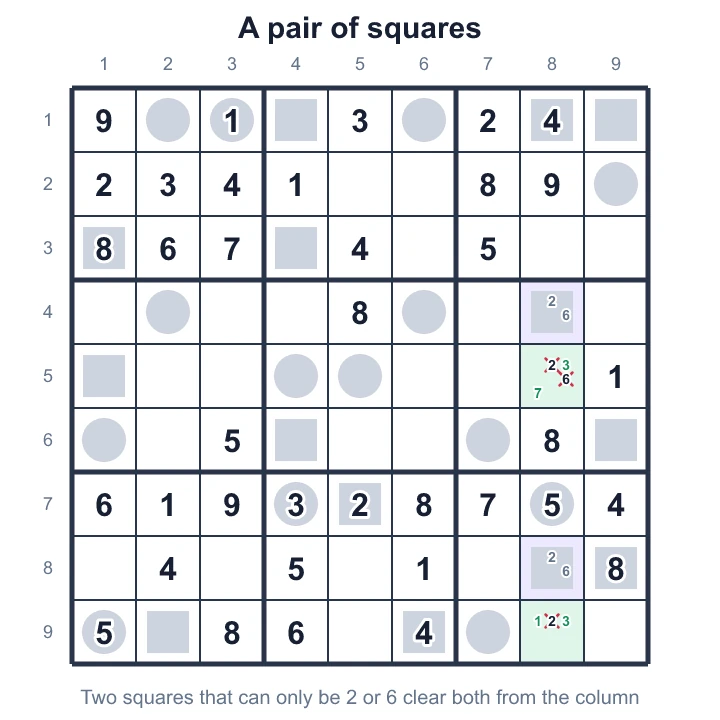
Seeing it. The squares in a unit share out only four digits, 2, 4, 6 and 8, so groups appear quickly. Look for two squares that can only be one pair of digits, or three that can only be three. The circles share out five digits, so look there too. In the diagram, column 8 already has a 4 and an 8, so the two squares, row 4, column 8 and row 8, column 8, can only be 2 or 6.
Using it. They take those digits between them, so remove them from every other cell in the unit. Plain cells count too. The green cells, row 5, column 8 and row 9, column 8, lose their 2, and row 5, column 8 loses its 6 as well.