How to solve Consecutive Sudoku
Consecutive Sudoku is ordinary Sudoku with bars between some neighbouring cells. A bar tells you two digits are one apart, and an empty edge tells you they aren't, so every edge in the grid is a clue.
Start here
The rules
Fill the grid so that every row, every column and every 3×3 box holds the digits 1 to 9 once each.
In Consecutive Sudoku, a white bar between two neighbouring cells means their digits are consecutive, such as 4 and 5. Where there's no bar, the digits are not consecutive.
Consecutive Sudoku strategies
These six techniques put the bars to work. Everything in How to solve Sudoku still applies. Take care with unique rectangles: swapping the two digits of a rectangle has to leave every bar and every gap as it was, so check the edges round its corners before you rely on one.
A few terms first. A bar is the small white rectangle between two neighbouring cells. It means the two digits are consecutive, like 4 and 5. In our puzzles the rule works both ways: where there's no bar, the two digits are not consecutive. A run is a line of cells joined by bars.
The diagrams use the same colours as our other guides. Green marks the cell the step is about and the answer it gives you. Blue marks the cells it depends on. Purple marks the cells you're scanning. Red with a cross is a candidate you can remove.
Read the empty edges as well as the bars. Every gap between two cells is a clue too.
Bars beside known digits
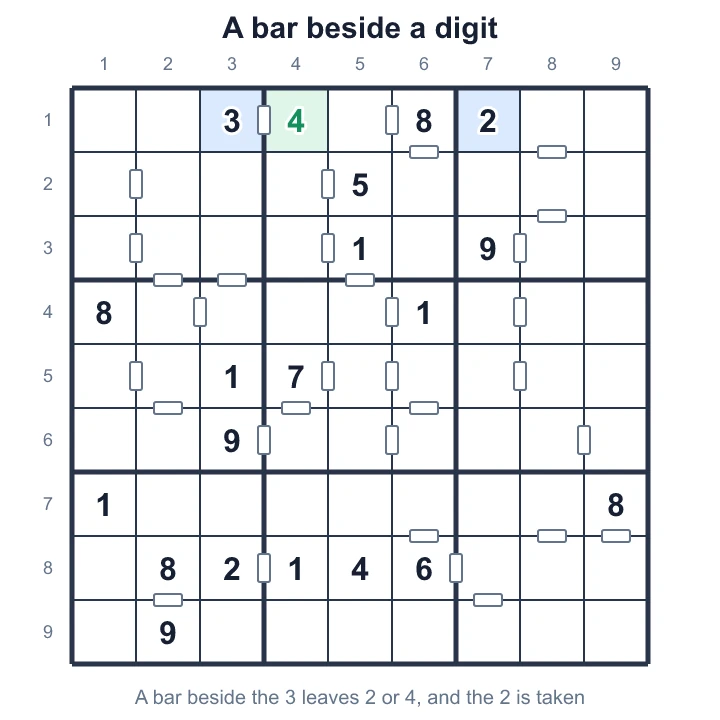
A bar beside a digit
Seeing it. A bar beside a digit you know gives its neighbour two candidates, one above and one below. Beside a 4 it's 3 or 5. Beside a 1 or a 9 there's only one: 2 or 8. In the diagram, the green cell, row 1, column 4, has a bar to the 3 beside it.
Using it. If it's a 1 or a 9, write the answer in. Otherwise, check which of the two the row, column and box already hold. A bar to a 3 means 2 or 4, and row 1 already has a 2, in column 7, so the green cell is 4.
If a digit has bars on both sides along a row or column, the two neighbours are in the same line, so they differ. They're the digit above and the digit below, in some order. That's a naked pair, so remove both from the rest of the line. It works for a bend too, if the two neighbours are in the same box.
Bars beside known digits
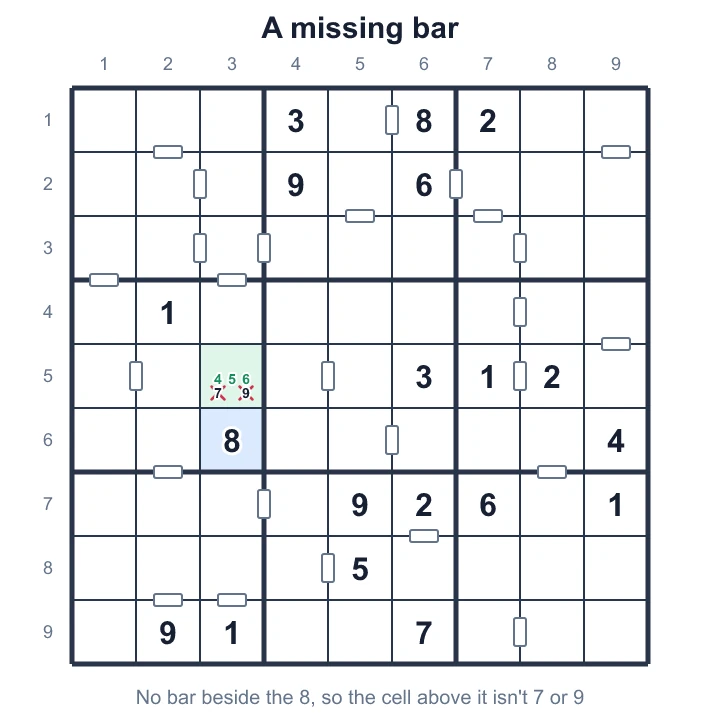
A missing bar
Seeing it. Where a known digit has no bar beside it, the neighbour isn't one above or one below. In the diagram, the known digit is the 8 in row 6, column 3, and the green cell above it, row 5, column 3, has no bar between them.
Using it. Remove the digit above and the digit below from the neighbour. Here that's 7 and 9. Beside a 5, it would be 4 and 6. A digit has up to four neighbours, so it can rule out as many as eight candidates at once. It pays to go round the starting digits doing this before you do anything else.
Bars between two unknown cells
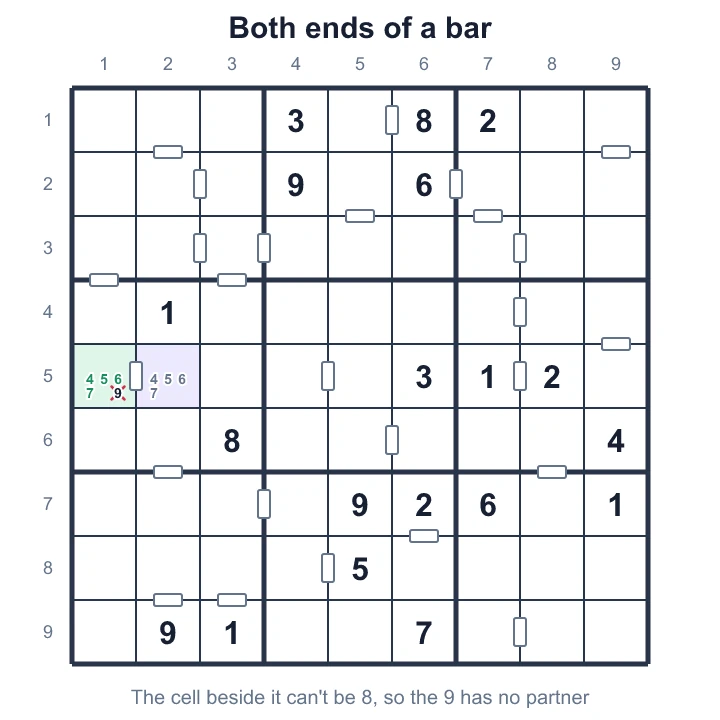
Both ends of a bar
Seeing it. A bar joins two cells whose digits differ by 1, so every candidate in one cell needs a partner in the other. Write both cells' candidates side by side. In the diagram, row 5, column 1 can be 4, 5, 6, 7 or 9, and its partner, row 5, column 2, can be 4, 5, 6 or 7.
Using it. Test each candidate. The 4 has the 5, the 5 has the 4 or 6, the 6 has the 5 or 7, and the 7 has the 6. The 9 would need an 8, and the other cell can't be 8, so the 9 goes. Every bar joins one odd digit and one even digit, so if one cell can only be odd, the other can only be even.
Bars between two unknown cells
Both ends of a missing bar
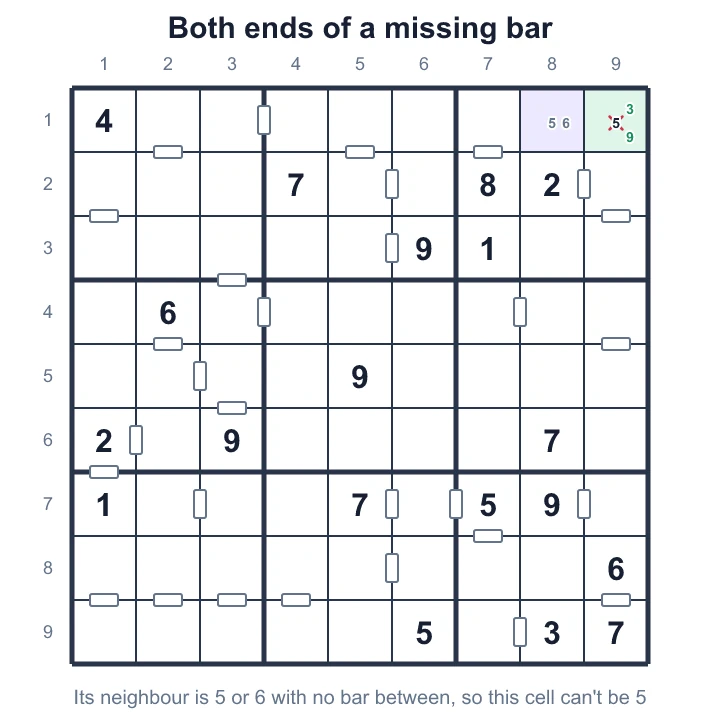
Seeing it. Two neighbouring cells with no bar between them can't be equal, and they can't be one apart. Look for a cell with only two or three candidates beside a cell with no bar. In the diagram, row 1, column 8 can only be 5 or 6, and the green cell next to it, row 1, column 9, can be 3, 5 or 9.
Using it. Test each candidate in the green cell. If it were 5, the neighbour couldn't also be 5, so it would be 6, which is one away. So the 5 goes. A 3 or a 9 is safe, because neither is within one of 5 or 6. If the neighbour could only be 4 or 6, the green cell couldn't be 5 either, since 5 is within one of both.
Runs
Two bars on one cell
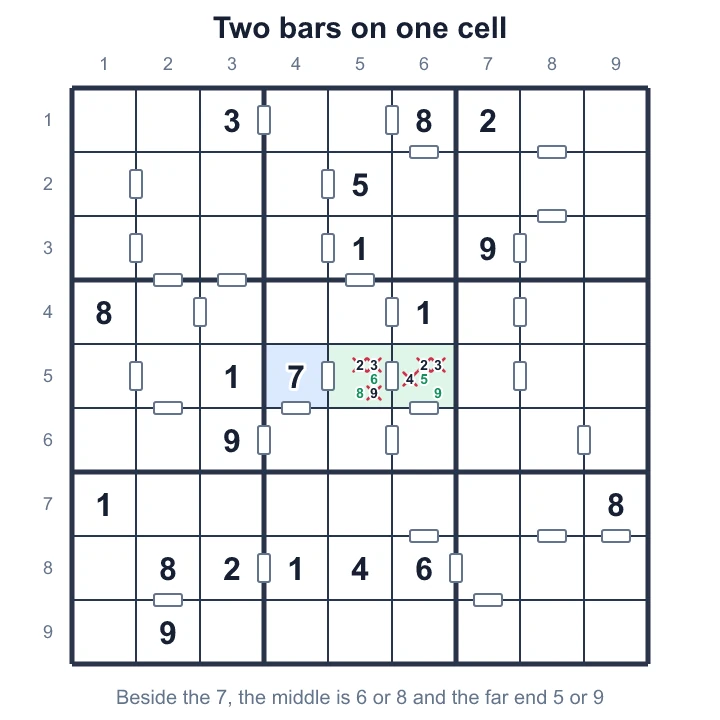
Seeing it. Look for a cell with a bar on each side along a row or column. Its two neighbours are in the same line, so they differ, and each is one away from the cell. One is the digit above and the other the digit below. The three cells hold three consecutive digits in order, counting up or down. In the diagram, the middle cell is row 5, column 5, with a bar to the 7 on its left and a bar to row 5, column 6 on its right.
Using it. The 7 makes the middle cell 6 or 8, and the far end is then 5 or 9. Everything else can go: remove 2, 3 and 9 from the middle cell, and 2, 3 and 4 from the far end. Check the row, column and box to choose between what's left.
The middle cell of any three like this can't be 1 or 9. That makes hidden singles for 1 and 9 easier, because every cell with bars on both sides is out. The two ends differ by two, so they have the same parity and the middle cell has the other.
The same holds for a bend, such as a bar to the left and a bar above, as long as the two neighbours are in the same box. They see each other, so they can't match. If they're in different boxes, they might both be the same digit, and nothing follows.
Runs
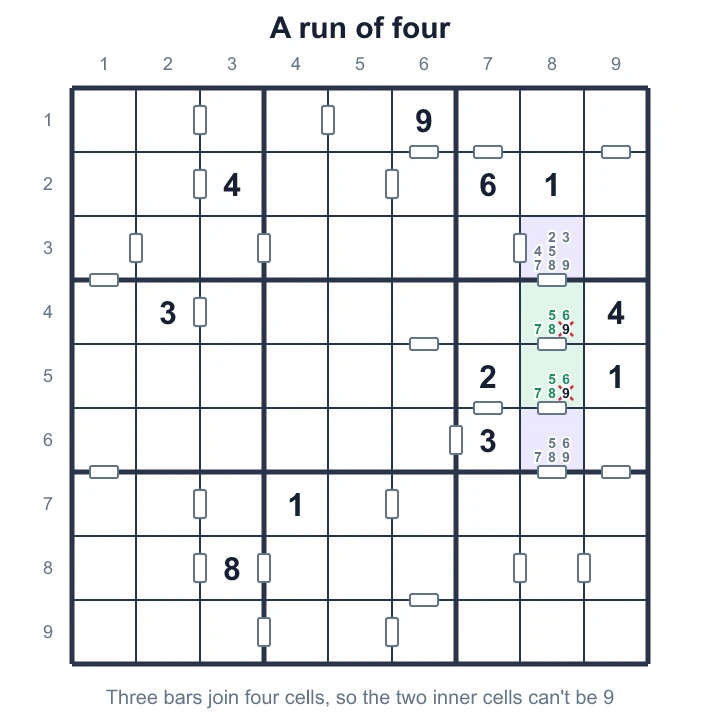
Long runs
Seeing it. Three bars in a row join four cells, and the digits are consecutive and in order, such as 3, 4, 5, 6 or 6, 5, 4, 3. The cells are in one line, so none of them can repeat. In the diagram, the run is down column 8, from row 3 to row 6.
Using it. The run limits every cell in it, and the limit depends on how far the cell is from the nearer end. The second cell in can only be 2 to 8, so it can't be 1 or 9. The third can only be 3 to 7, and the fourth 4 to 6. Here the two inner cells, rows 4 and 5, can't be 9. Parity alternates along the run, odd then even then odd.
Once you know one digit in a run, there are only two ways it can go, up or down. A second digit, or a cell where one direction won't fit, settles it.