How to solve Center Dot Sudoku
Center Dot Sudoku is ordinary Sudoku with one extra unit: the centre cell of every box. The nine centre cells line up in threes along rows and columns, so a single digit can rule out several of them at once.
Start here
The rules
Fill the grid so that every row, every column and every 3×3 box holds the digits 1 to 9 once each.
In Center Dot Sudoku, the nine centre cells, one in each box, also hold 1 to 9 once. They're the cells where rows 2, 5 and 8 cross columns 2, 5 and 8.
Center Dot Sudoku strategies
These six techniques put the centre cells to work. Everything in How to solve Sudoku still applies, with the centre cells counted as one more unit. Take care with unique rectangles: a rectangle is only a deadly pattern if the centre cells hold none of its corners, or two side by side in the same row or column.
A few terms first. The centre cells are row 2, row 5 and row 8 crossed with column 2, column 5 and column 8. Each box has exactly one, in the same place, so a digit in the centre of one box can't be in the centre of any other. Three centre cells sit on each of those rows and columns, which is where most of the extra logic comes from. In the diagrams the centre cells are shaded grey with a small dot.
The diagrams use the same colours as our other guides. Green marks the cell the step is about and the answer it gives you. Blue marks the cells it depends on. Purple marks the cells you're scanning. Red with a cross is a candidate you can remove.
Remember to check the centre cells as you would any other unit.
Singles in the centre cells
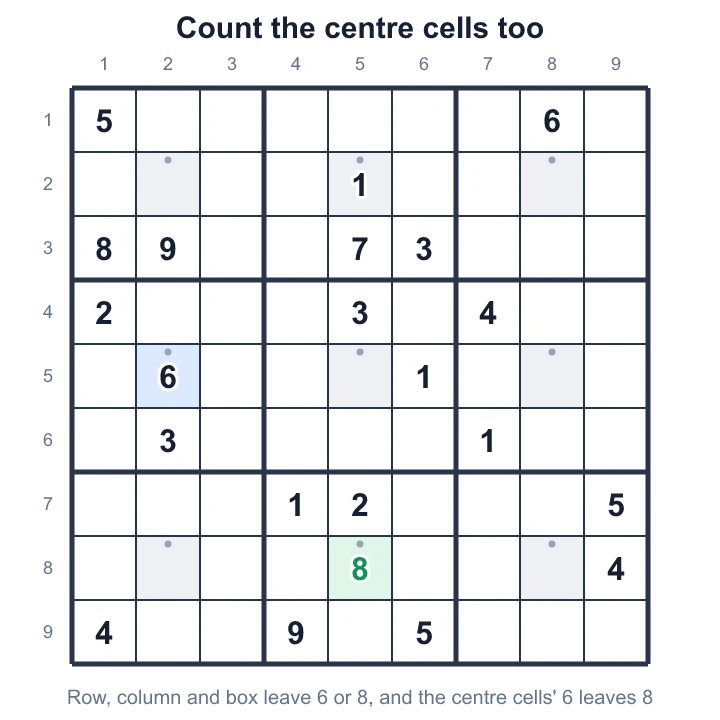
Count the centre cells too
Seeing it. A centre cell has four neighbours that aren't in its row, column or box, so it's often down to one candidate sooner than you'd expect. In the diagram, the green cell is row 8, column 5, the centre of box 8. Its row, column and box hold every digit except 6 and 8.
Using it. Now look at the other centre cells. Row 5, column 2 is already 6, so the green cell can't be 6 and must be 8. When you list the candidates for a centre cell, always include the digits in the other centre cells.
Centre cells, rows and columns
Centre cells along a row or column
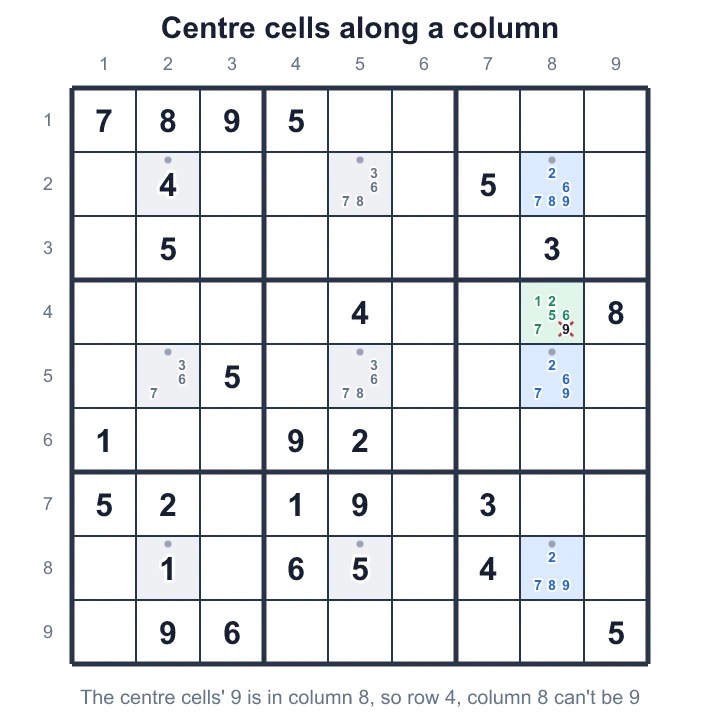
Seeing it. This works like a pointing pair. Look for a digit whose only places among the centre cells are on one row or one column. In the diagram, the centre cells can only take 9 in column 8: row 2, row 5 or row 8.
Using it. The centre cells' 9 is in column 8, so column 8's 9 is one of those three cells. Remove 9 from the rest of the column. Here that's the green cell, row 4, column 8.
Centre cells, rows and columns
A row or column that points into the centre cells
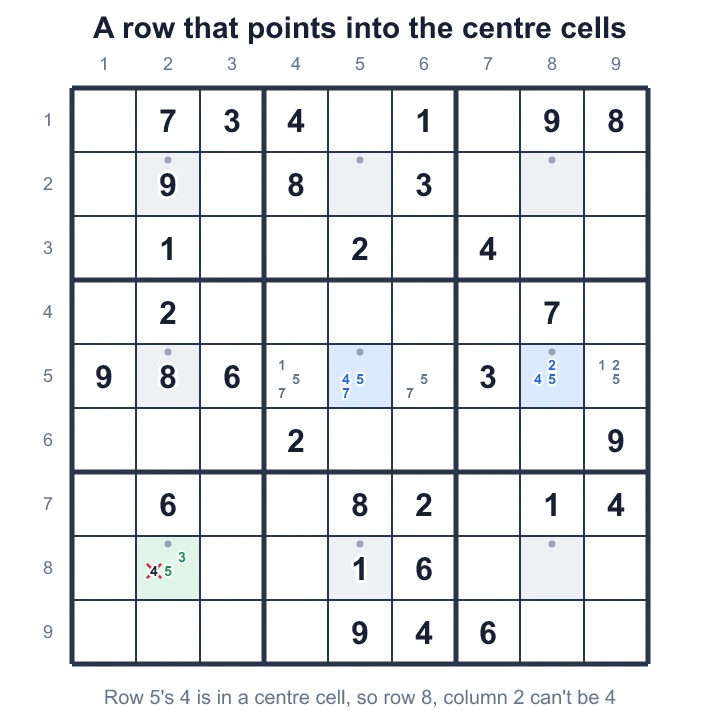
Seeing it. Now turn it round. Look for a row or column whose only places for a digit are its centre cells. In the diagram, row 5 can only take 4 in row 5, column 5 or row 5, column 8, and both are centre cells.
Using it. Row 5's 4 is in a centre cell, so the centre cells' 4 is in row 5, and no centre cell outside row 5 can be 4. The green cell, row 8, column 2, loses its 4 and is left with 3 or 5.
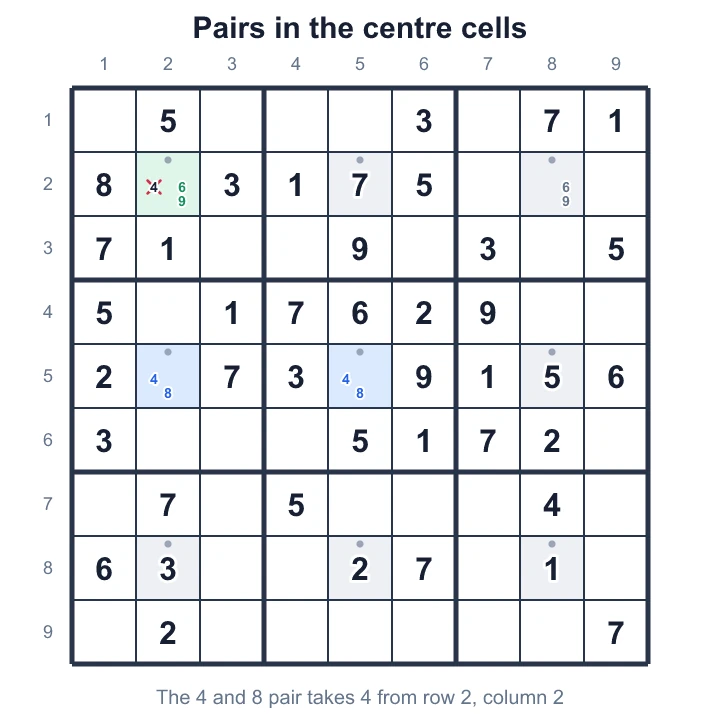
Pairs in the centre cells
Pairs in the centre cells
Seeing it. Naked pairs and triples work across the centre cells exactly as they do in a box. In the diagram, row 5, column 2 and row 5, column 5 can only be 4 or 8.
Using it. Those two cells take the centre cells' 4 and 8 between them, so no other centre cell can be 4 or 8. The green cell, row 2, column 2, loses its 4 and is left with 6 or 9.