How to solve Argyle Sudoku
Argyle Sudoku is ordinary Sudoku with eight extra lines drawn across the grid in a criss-cross pattern. No digit repeats on any line, but a line doesn't have to hold every digit, and that changes which techniques work.
Start here
The rules
Fill the grid so that every row, every column and every 3×3 box holds the digits 1 to 9 once each.
In Argyle Sudoku, no digit repeats on any of the eight lines. Four long lines of eight cells run just off the two main diagonals, one step either side of each. Four short lines of five cells form a diamond that joins the middle of each edge of the grid to the middle of the next. A line doesn't have to hold every digit.
Argyle Sudoku strategies
These five techniques put the lines to work. Everything in How to solve Sudoku still applies, with each line counted as one more unit in which no digit can repeat. A line doesn't hold every digit, though, so hidden singles don't work on it the way they do in a row, column or box. What the lines give you instead is cells that see each other, and one new idea: finding the digit a line is missing. Take care with unique rectangles: a corner on a line can break the pattern, so only use one when no corner of the rectangle is on a line.
A few terms first. There are eight lines. Four are long, with eight cells each: they run corner to corner just off the two main diagonals, one step either side of each. Four are short, with five cells each: they're the four sides of a diamond that joins the middle of each edge of the grid to the middle of the next. The main diagonals themselves are not lines. Where the long lines cross, four cells sit around the centre: row 4, column 5; row 5, columns 4 and 6; and row 6, column 5. Each of those is on two lines. In the diagrams the lines are thin grey lines through the middle of the cells.
The diagrams use the same colours as our other guides. Green marks the cell the step is about and the answer it gives you. Blue marks the cells it depends on. Purple marks the cells you're scanning. Red with a cross is a candidate you can remove.
Remember to check the lines as you would any other unit, but only for digits already on them.
Singles on the lines
Count the lines too
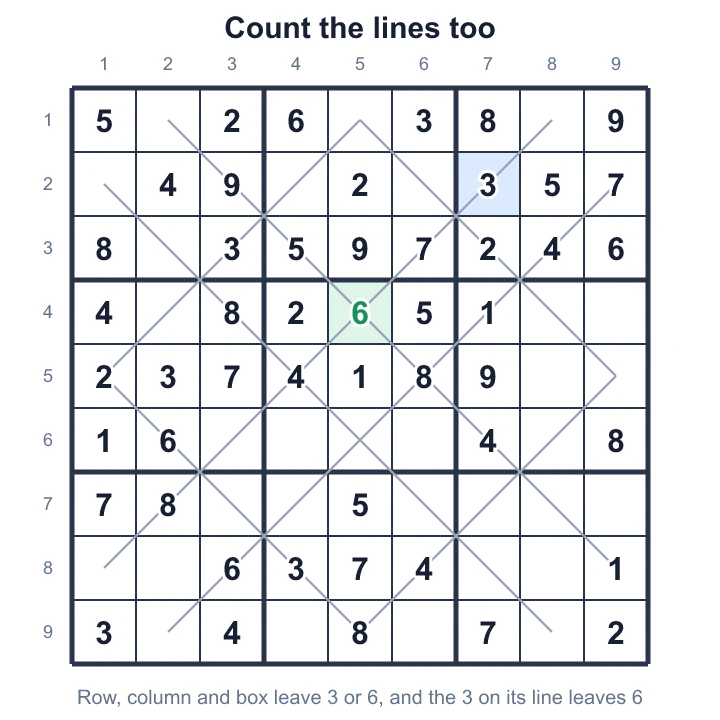
Seeing it. A cell on a line sees every other cell on it, so it's often down to one candidate sooner than you'd expect. A cell where two long lines cross has seven line-mates on each. In the diagram, the green cell is row 4, column 5, where two long lines cross. Its row, column and box hold every digit except 3 and 6.
Using it. Now look along its lines. Row 2, column 7 is on the long line that runs up to the right, and it's already 3, so the green cell can't be 3 and must be 6. When you list the candidates for a cell on a line, always check the digits already on that line.
Lines and boxes
A box that points along a line
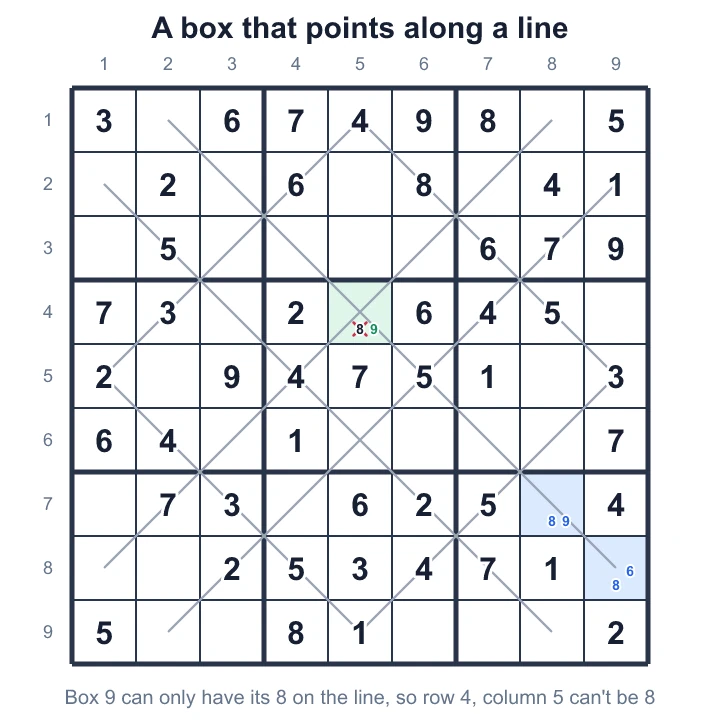
Seeing it. This works like a pointing pair. Look for a digit whose only places in a box are cells of one line. A long line passes through up to five boxes, and a short one through three. In the diagram, box 9 can only take 8 in row 7, column 8 or row 8, column 9, and both are on the long line that runs down to the right.
Using it. Box 9's 8 is on that line, so no other cell on the line can be 8. The green cell, row 4, column 5, loses its 8 and is left with 9. A row or column crosses a line in only one cell, so rows and columns can't point along a line this way.
Pairs on the lines
Pairs along a line
Seeing it. Naked pairs work along a line the way they do in a box: two cells whose only candidates are the same two digits. In the diagram, row 1, column 2 and row 4, column 5 can only be 2 or 3, and they're on the same long line.
Using it. Those two cells take 2 and 3 between them, so no other cell on the line can be 2 or 3. Row 2, column 3 and row 3, column 4, which sit between them, lose their 3 and are left with 5 and 9. Hidden pairs don't work on a line unless you know the line holds both digits, which is what the next technique is for.

The missing digit
Find the missing digit
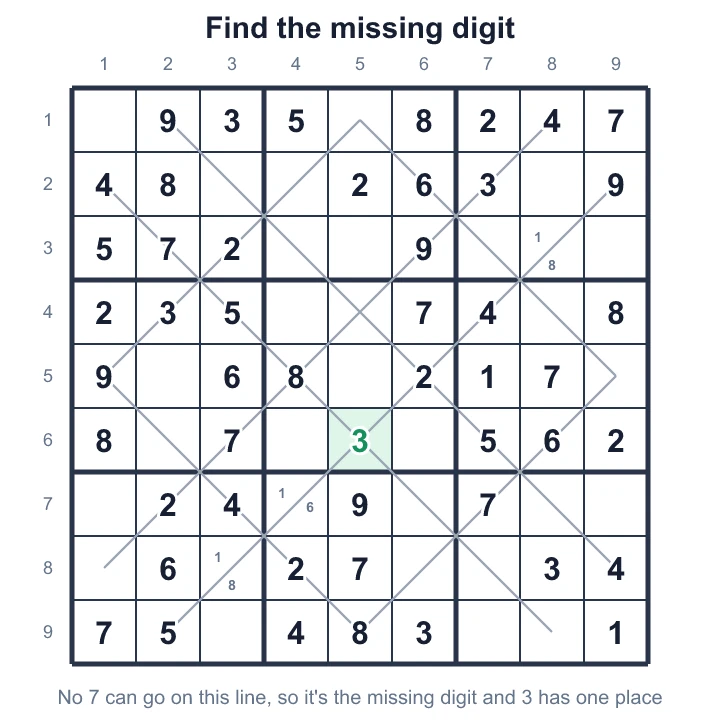
Seeing it. A long line has eight cells and there are nine digits, so exactly one digit is missing from it. Until you know which, you can't say that a digit has to be somewhere on the line. Look for a digit that isn't on the line and can't go in any of its empty cells: that's the missing one. In the diagram, the long line that runs down to the left already has 9, 4, 2 and 5 on it, and none of its four empty cells can be 7.
Using it. So 7 is the missing digit, and the line holds every other digit. It still needs 1, 3, 6 and 8, and now hidden singles work. Only row 6, column 5 can take a 3, so it's 3. Short lines have five cells, so they miss four digits and this doesn't help there.
Cells that see two places
Two places seen by a line
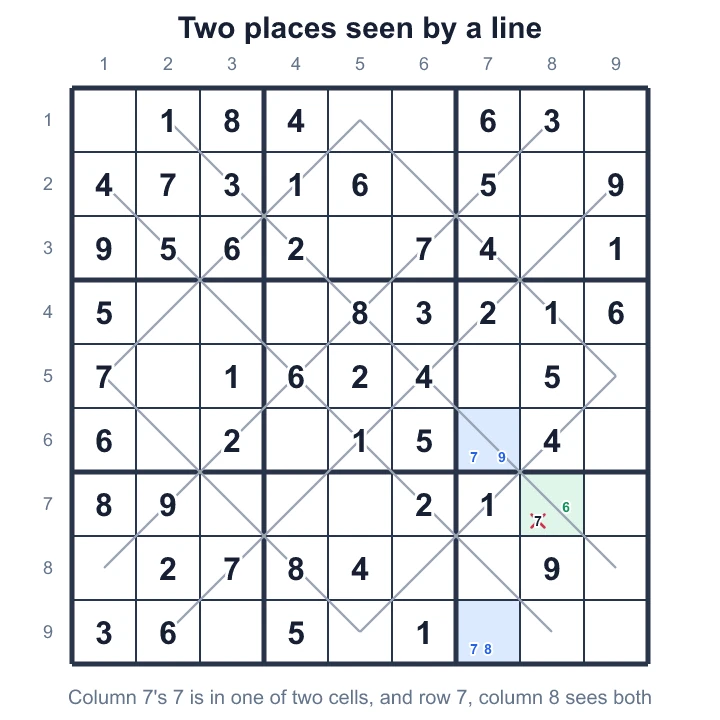
Seeing it. Look for a digit with exactly two places in a row, column or box, then for a cell that sees both of them. A line lets a cell see a place it would never reach through its row, column or box. In the diagram, column 7 can only take 7 in row 6 or row 9, and row 6, column 7 is on the long line that runs down to the right.
Using it. One of those two cells is 7. The green cell, row 7, column 8, is on that line with the first and in box 9 with the second, so whichever holds the 7, the green cell sees it. It can't be 7 and is left with 6.